What is Fadogia Agrestis?
Fadogia agrestis, a shrub native to West Africa, particularly Nigeria and Ghana, has a rich history in traditional African medicine. It has been used as an aphrodisiac and to promote vitality and strength. It is important to note that scientific research on F. agrestis is limited, and most studies are based on animal models, primarily rats. Human clinical trials are extremely scarce.Fadogia Agrestis: Mechanism of Action
F. agrestis is believed to influence testosterone levels by stimulating the pituitary gland. This stimulation leads to an increased release of luteinizing hormone (LH). LH then signals the Leydig cells within the testes to produce more testosterone. The bioactive compounds thought to be responsible for these effects are alkaloids and saponins. However, the precise mechanisms and the specific roles of these compounds are still under investigation.Pharmacology and Bioactive Compounds of Fadogia Agrestis
Fadogia agrestis (Schweinf. ex Hiern) is a shrub in the Rubiaceae family, the same botanical family as coffee. Phytochemical screening of the stem reports alkaloids, saponins, flavonoids, and anthraquinones as the main constituent groups. In our review of the literature, the saponin fraction is the constituent most often linked to the plant’s effect on male hormonal markers in animal models. The proposed pharmacology centers on the hypothalamic-pituitary-gonadal axis. In rodent studies, an aqueous stem extract was associated with higher serum testosterone, and researchers have suggested a luteinizing-hormone-like action on testicular Leydig cells as one possible pathway (Yakubu et al., 2005, Asian Journal of Andrology, PMID: 16281088). A later mechanistic rat study examined how the extract interacts with biomolecules in testicular and penile tissue (Ogunro and Yakubu et al., 2023, Reproductive Sciences, PMID: 35969364). It is important for readers to understand that this pharmacology is characterized in animal models. Human pharmacokinetic data for Fadogia agrestis remains limited, which is why dosing and duration deserve a conservative, structure/function framing rather than firm clinical promises.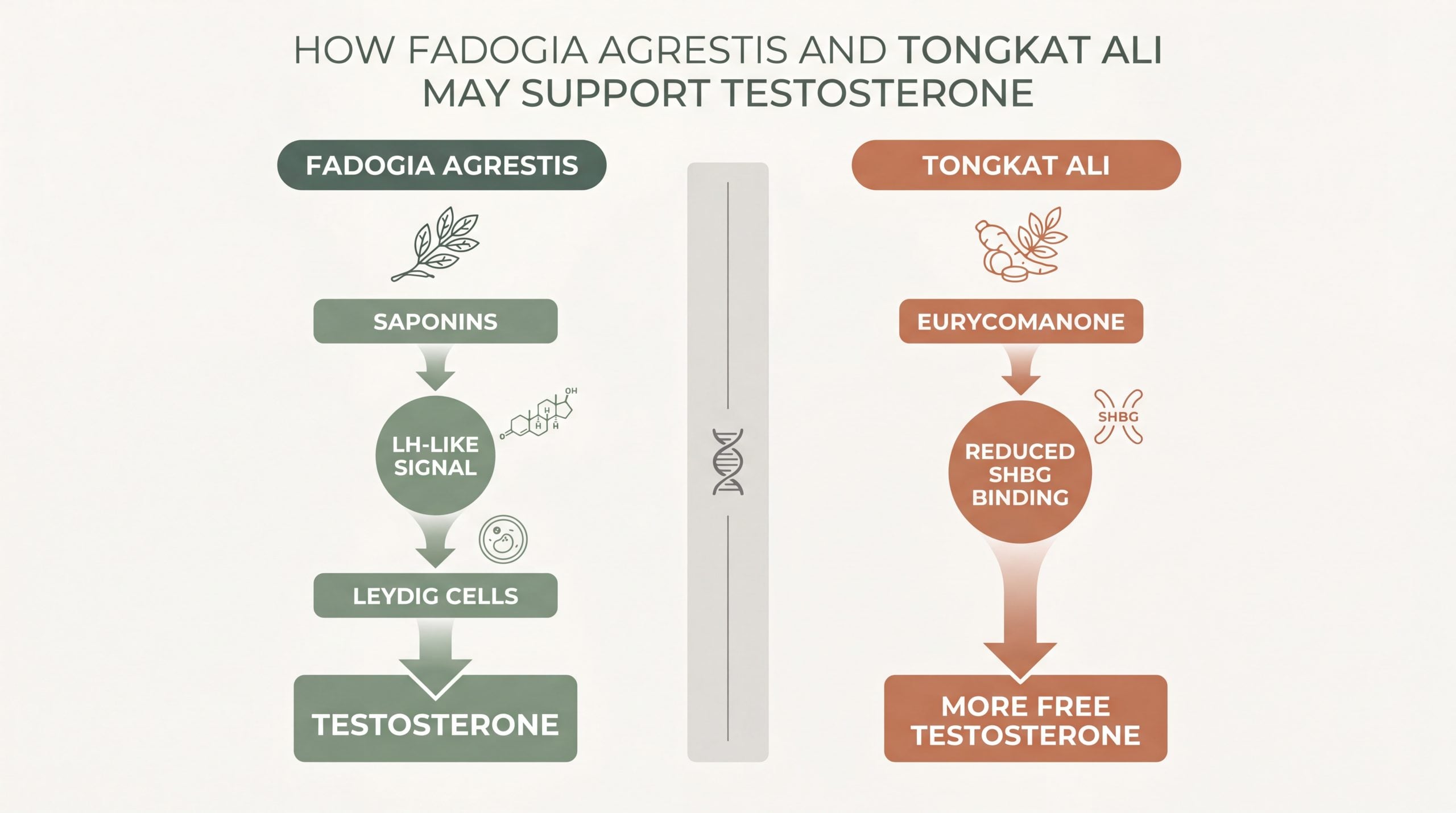
What is Tongkat Ali?
Tongkat Ali, scientifically known as Eurycoma longifolia, is a plant native to Southeast Asia, found in countries like Malaysia, Indonesia, and Thailand. It has a long history of use in traditional medicine in these regions, known for addressing fatigue, loss of libido, erectile dysfunction, and male infertility. Unlike F. agrestis, Tongkat Ali has been the subject of more extensive research, including some human clinical trials.
Tongkat Ali: Mechanism of Action
Tongkat Ali’s mechanisms for supporting testosterone are better understood than those of F. agrestis. While it may also influence LH levels, its primary actions involve:
- Aromatase Inhibition: Eurycomanone, a key bioactive compound in Tongkat Ali, is known to inhibit the aromatase enzyme. This enzyme converts testosterone into estrogen. By inhibiting aromatase, Tongkat Ali helps maintain higher testosterone levels.
- Sex Hormone Binding Globulin (SHBG) Reduction: Tongkat Ali may also reduce SHBG levels. SHBG is a protein that binds to testosterone, making it inactive. By reducing SHBG, Tongkat Ali increases the amount of free testosterone available in the body.
- Cortisol Reduction: Studies suggest Tongkat Ali may have effects on the stress hormone, cortisol.
Tongkat Ali: Bioactive Compounds
Eurycomanone is considered the primary bioactive compound responsible for many of Tongkat Ali’s effects. It belongs to a group of compounds called quassinoids, which are known for their diverse biological activities.
Potential Benefits of Fadogia Agrestis
Based on traditional use and limited animal studies, F. agrestis is suggested to offer the following potential benefits:
Testosterone Support
Some animal studies indicate that F. agrestis may increase testosterone levels. However, it is vital to reiterate that human evidence is lacking.The most cited evidence here comes from animal research. An aqueous Fadogia agrestis stem extract was associated with higher serum testosterone in male rats (Yakubu et al., 2005, Asian Journal of Andrology, PMID: 16281088). In our editorial assessment, this is a promising structure/function signal, though it has not yet been confirmed in controlled human trials, so we frame Fadogia as traditionally used to support healthy testosterone rather than as a proven testosterone treatment.
Libido and Sexual Function
Traditionally, F. agrestis has been used as an aphrodisiac. Animal studies provide some support for this use, but human trials are needed to confirm these effects.Rodent models have also linked Fadogia agrestis stem extract to markers of male sexual behavior and to biomolecules in erectile tissue (Ogunro and Yakubu et al., 2023, Reproductive Sciences, PMID: 35969364). Human data on libido remains limited, so readers should treat these findings as early and traditional-use context rather than a guarantee of results.
Potential Anti-inflammatory and Antioxidant Effects
Preliminary research suggests F. agrestis may possess anti-inflammatory and antioxidant properties. Further investigation is required to confirm these effects and their significance.
Potential Benefits of Tongkat Ali
Tongkat Ali, with more supporting research, is associated with a broader range of potential benefits:
Testosterone Support
Human studies provide some evidence that Tongkat Ali can increase testosterone levels, particularly in men with low testosterone.
Libido and Sexual Function
Tongkat Ali has shown promise in improving libido, erectile function, and even sperm quality (motility and concentration) in some human studies.
Stress Reduction
Tongkat Ali is considered an adaptogen – a substance that helps the body adapt to stress. Studies suggest it can lower cortisol levels and improve mood.
Athletic Performance
Some research indicates that Tongkat Ali may improve aspects of athletic performance, such as strength and endurance.
Cognitive Benefits
By supporting testosterone levels and reducing stress, Tongkat Ali may contribute to improved mood and cognitive function, including focus.
Immune System Support
Preliminary research suggests Tongkat Ali may have immune-boosting properties, but further studies are needed.
Fadogia Agrestis vs. Tongkat Ali: A Comparison
| Feature | Fadogia Agrestis | Tongkat Ali (Eurycoma longifolia) |
|---|---|---|
| Origin | West Africa | Southeast Asia |
| Traditional Use | Aphrodisiac, vitality | Vitality, libido, stress |
| Research | Primarily animal studies | More human studies |
| Mechanism | LH stimulation | Aromatase inhibition, SHBG reduction, cortisol reduction |
| Bioactive Compounds | Alkaloids, Saponins. | Eurycomanone, quassinoids |
| Safety Profile | Potential liver/kidney concerns | Generally safer, but side effects possible |
It is important to state that there is very little scientific evidence on the combination of F. agrestis and Tongkat Ali.
Fadogia Agrestis vs. Other Natural Testosterone Boosters
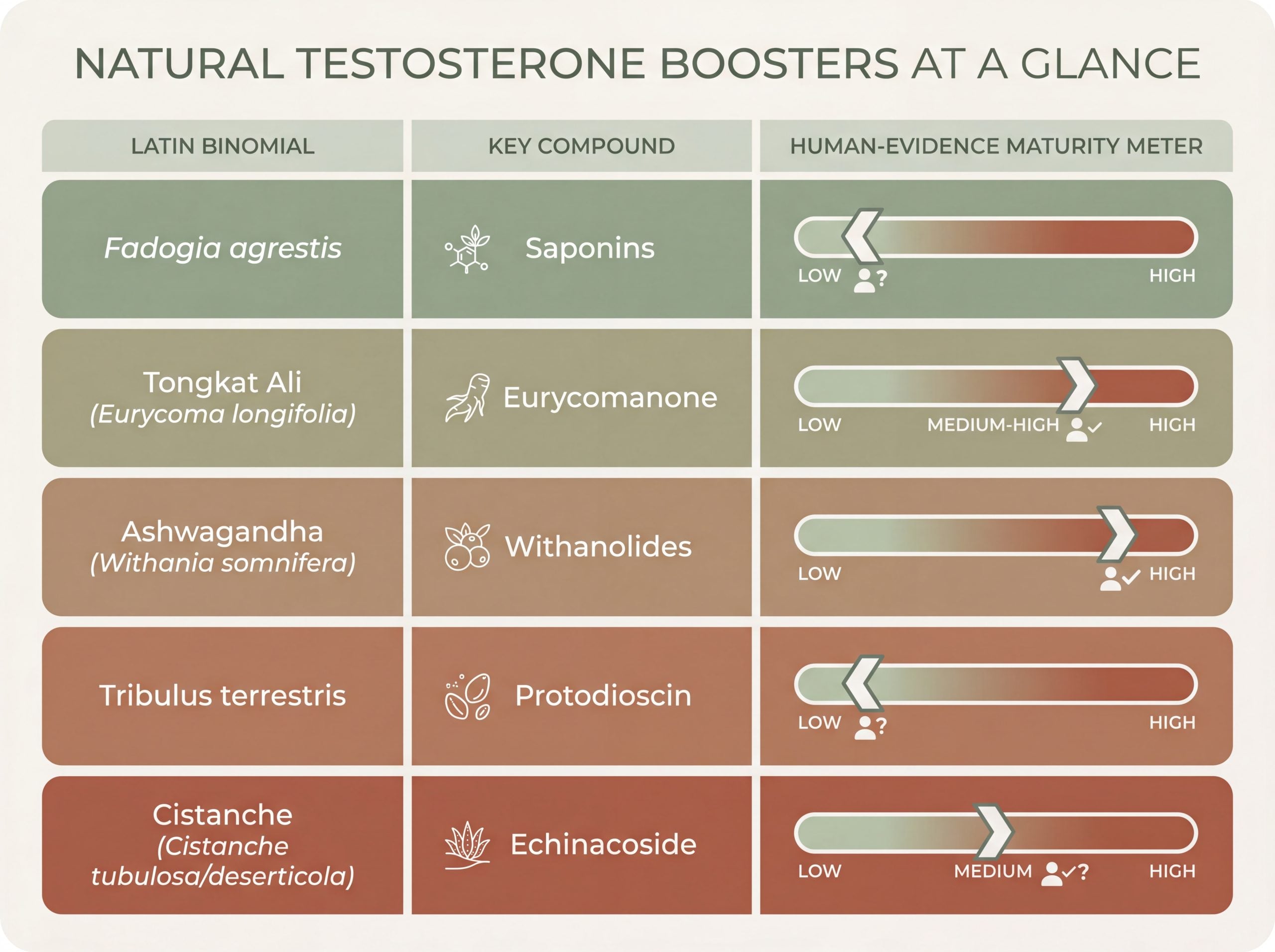
Readers comparing Fadogia agrestis almost always weigh it against the wider category of botanicals traditionally used to support healthy testosterone and male vitality. From our editorial review of the evidence base, the herbs below differ sharply in how mature their human research is. Tongkat Ali and ashwagandha carry randomized human trials, while Fadogia agrestis rests mainly on animal data. We have laid out the category so the trade-offs are clear at a glance.
| Botanical | Latin binomial | Key compounds | Traditional structure/function use | Human evidence maturity |
|---|---|---|---|---|
| Fadogia agrestis | Fadogia agrestis | Saponins, alkaloids, flavonoids | Traditionally used to support male libido and testosterone | Animal models only, limited human data |
| Tongkat Ali | Eurycoma longifolia | Quassinoids, eurycomanone | Traditionally used to support testosterone and stress resilience | Randomized human trials available |
| Ashwagandha | Withania somnifera | Withanolides | Traditionally used to support a healthy stress response | Randomized human trials available |
| Tribulus terrestris | Tribulus terrestris | Steroidal saponins (protodioscin) | Traditionally used to support libido | Mixed human trials, often on libido rather than testosterone |
| Cistanche | Cistanche deserticola | Phenylethanoid glycosides (echinacoside) | Traditionally used in TCM to support kidney yang and vitality | Mostly preclinical, emerging human data |
| Evidence-maturity ratings reflect our editorial reading of the published literature as of June 2026 and are not a measure of effectiveness. | ||||
The practical takeaway from our assessment: if a reader wants the most human-studied option in this category, Tongkat Ali (Eurycoma longifolia) and ashwagandha (Withania somnifera) are further along the evidence curve than Fadogia agrestis. Those who want to read deeper can compare our notes on black maca for men as another traditional option.
Safety, Side Effects, and Risks
Fadogia Agrestis
While traditional use suggests some level of safety, concerns exist regarding potential liver and kidney toxicity with long-term use or high doses of F. agrestis, based on some animal studies. Long-term human data is lacking. One point deserves direct attention. In rat studies, prolonged or higher-dose administration of Fadogia agrestis stem extract was associated with changes in testicular function indices and signs of organ stress, which has raised questions about safety at heavy or extended dosing (Yakubu et al., 2008, Journal of Ethnopharmacology, PMID: 18023305). Discussions of liver and organ tolerance in the wider supplement community trace back to this type of animal finding. Because controlled human safety data is limited, our editorial team takes a conservative position: keep servings modest, avoid stacking multiple strong hormonal herbs at once, cycle rather than use continuously, and consult a qualified healthcare provider before starting, especially for anyone with a liver condition or taking medication.Tongkat Ali
Tongkat Ali generally has a better-established safety profile due to more extensive research. However, side effects like insomnia and irritability are possible, particularly at higher doses.Contamination Risks
Herbal supplements can be contaminated with heavy metals (lead, mercury) or other substances. It is important to choose reputable brands that provide third-party testing results.Drug Interactions
- Fadogia Agrestis: May interact with hormone-related medications.
- Tongkat Ali: May interact with medications like propranolol (for high blood pressure) and potentially medications for diabetes.
Dosage and Usage Guidelines
Fadogia Agrestis
Due to limited human research, it’s best to state a range. Commonly used doses in supplements range from 300-600 mg per day, but it’s important to start low and consult a healthcare professional.Tongkat Ali
Studies often use 200-400 mg per day of a standardized Tongkat Ali extract.Standardized Extracts (Tongkat Ali)
Choosing standardized extracts of Tongkat Ali, preferably standardized to a specific percentage of eurycomanone (e.g., 2-3%), helps ensure consistent potency.Cycling
Cycling F. agrestis (e.g., taking it for a few weeks, then taking a break) is a common practice to potentially minimize risks, although this is not definitively proven.Forms
Both herbs are available in various forms, including capsules and powders.Choosing Quality Supplements
- Third-Party Testing: Look for products that have been tested by independent laboratories for purity, potency, and the presence of contaminants.
- Reputable Brands: Choose well-known and respected brands with a history of quality.
- Standardized Extracts (for Tongkat Ali): Prioritize Tongkat Ali products that specify the percentage of eurycomanone.
Frequently Asked Questions (FAQ)
Can women take Fadogia Agrestis or Tongkat Ali?
While primarily studied in men, some women use these herbs for potential libido or energy benefits. However, due to their influence on hormones, women should consult a healthcare professional before use.
How long does it take to see results?
Individual responses vary. Some users report noticing effects within a few weeks, while others may require longer periods of consistent use.
Can I take these herbs together?
Many people do combine Fadogia agrestis and Tongkat Ali, since they are often paired for complementary structure/function support. From our editorial review, a sensible approach is to take them with a meal that contains some fat to support absorption, start with the lower end of each herb’s range, and introduce one herb at a time so any reaction can be traced to a single source. Cycling is widely practiced with Fadogia, for example, a few weeks on followed by a break, rather than continuous daily use. If either herb is being stacked with other hormonal or stimulant supplements, space them out and watch how the body responds. Anyone on medication, or with a liver, heart, or hormone-sensitive condition, should consult a healthcare provider before combining supplements.
Are these herbs legal?
The legal status of these herbs varies by country. In the United States, they are generally sold as dietary supplements. Check local regulations before purchasing.
Evidence and References
The hormonal and libido statements on this page are grounded in the primary research and authority resources below. Where evidence comes from animal models, we say so. Our editorial team verified each citation against its source in June 2026.
- Yakubu MT, Akanji MA, Oladiji AT (2005). Aphrodisiac potentials of the aqueous extract of Fadogia agrestis stem in male albino rats. Asian Journal of Andrology. PMID: 16281088
- Yakubu MT, Akanji MA, Oladiji AT (2008). Effects of oral administration of aqueous extract of Fadogia agrestis stem on some testicular function indices of male rats. Journal of Ethnopharmacology. PMID: 18023305
- Tambi MI, Imran MK, Henkel RR (2012). Standardised water-soluble extract of Eurycoma longifolia (Tongkat Ali) as a testosterone booster for managing men with late-onset hypogonadism. Andrologia. PMID: 21671978
- Talbott SM, Talbott JA, George A, Pugh M (2013). Effect of Tongkat Ali on stress hormones and psychological mood state in moderately stressed subjects. Journal of the International Society of Sports Nutrition. PMID: 23705671
- National Institutes of Health, Office of Dietary Supplements. Dietary Supplements for Exercise and Athletic Performance. ods.od.nih.gov
- National Center for Complementary and Integrative Health. Herbs at a Glance. nccih.nih.gov
Disclaimer
These statements have not been evaluated by the Food and Drug Administration. This product is not intended to diagnose, treat, cure, or prevent any disease. Consult your healthcare provider before use, especially if you are pregnant, nursing, taking medication, or have a medical condition.