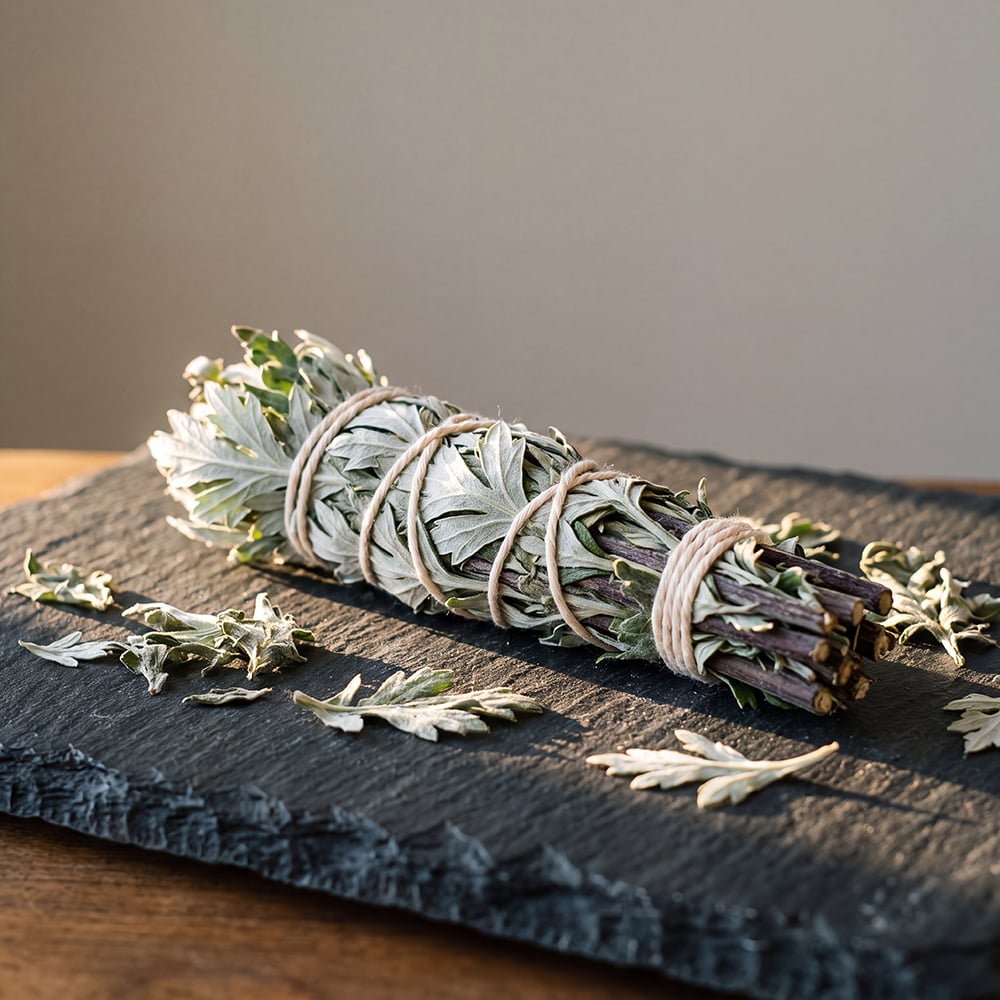
What Is a Black Mugwort Smudge Stick?
A black mugwort smudge stick is a hand-tied wand of dried mugwort (Artemisia vulgaris), the dark-stemmed herb burned for traditional smoke cleansing, dreamwork, and ritual. Our black mugwort smudge is single-herb: full mugwort leaf and flowering top, never padded with black sage or white sage filler. One 4-inch bundle, wrapped in natural cotton twine.
The Verdict (Internal Quality Score)
Grade A. Potency Score 9.4 of 10. Sourced as Pacific Northwest wildcrafted Artemisia vulgaris and shade-dried slowly to hold its aromatic terpenes and silvery-green leaf. Dense, resinous, and cleanly bundled with no wire and no glue. A dream-herb smudge that burns sweet, not harsh.
– Back To Your Roots Herbs Research Group
Sensory Analysis: Aroma of Our Mugwort Smudge Sticks
Our notes from handling the raw bundle:
Look
Silvery-green leaves over dark, semi-woody stems, tied into a firm 4-inch wand. The underside of each mugwort leaf shows the pale, felted silver that marks true Artemisia vulgaris.
Smell (Unlit)
Dry, green, and faintly sweet. A soft sage-adjacent bitterness sits under a honeyed top note.
Smoke
Warm and sweet-herbaceous with a light camphor lift. Rounder than white sage, with none of the acrid bite of a black-sage-heavy bundle.
How Does Black Mugwort Smudge Work?
- The Herb: Artemisia vulgaris (family Asteraceae), Pacific Northwest wildcrafted mugwort leaf and flowering top.
- The Mechanism: Gentle combustion releases the plant’s volatile aromatic terpenes as fragrant smoke, the same smoke long used to mark and cleanse a space.
- The Evidence: Analysis by Judzentiene and Budiene (2018) identified mugwort’s principal aromatic compounds as thujone isomers, camphor, and 1,8-cineole.
Aromatic Terpene Profile of Artemisia vulgaris
Mugwort’s scent is chemistry. The plant’s essential oil, roughly 0.1 to 1.4 percent of the dried leaf, carries the aromatic molecules below.
Thujone and Camphor
Alpha- and beta-thujone give mugwort its bittersweet, slightly medicinal edge. Camphor, reported near 15 to 23 percent of the oil in several wild populations, adds the cool lift you notice in the smoke. These are the chemical compounds that folklore tied to vivid dreams.
1,8-Cineole and Sabinene
1,8-cineole (eucalyptol) and sabinene round the aroma with a fresh, camphoraceous top note.
Black Mugwort vs White Sage vs Black Sage
Three herbs, three different smokes. White sage (Salvia apiana) burns bright and resinous. Black sage (Salvia mellifera) is earthier and often blended into mugwort bundles as filler. Black mugwort burns sweeter and softer, which is why it is the classic dream-herb and divination smoke.
The Dream Herb in Folklore and Ritual
Mugwort is one of the oldest ritual herbs on record. The Anglo-Saxon Nine Herbs Charm names it the oldest of worts. The genus Artemisia honors the goddess Artemis. Across Wiccan and folk traditions, mugwort is tied to divination, intuition, meditation, prophetic dreams, and the moon, and is set on the altar or under the pillow before dreamwork.
How to Use a Mugwort Smudge Stick
Step-by-Step Smoke Cleansing
- Open a window for airflow.
- Light the tip of the mugwort smudge stick, let it flame for several seconds, then blow it out so it smolders.
- Waft the smoke through your space, doorways, and corners with a hand or feather.
- Rest the wand on a heatproof dish or shell to extinguish. Never leave a burning smudge unattended.
A Note on Pairing
Mugwort pairs well with rosemary or cedar in a burn bundle when you want a greener, woodier smoke.
Critical Usage: Safety and Contraindications
Negative knowledge matters. Do not use mugwort smoke during pregnancy or while nursing, since mugwort is a traditional emmenagogue. People allergic to ragweed or other Asteraceae plants may react to mugwort. Burn only in a ventilated space, keep smoke away from detectors and pets, and fully extinguish after use.
Clinical Specs
| Spec | Detail |
|---|---|
| Serving Size | One 4-inch (10 cm) hand-tied wand |
| Frequency | As needed for space cleansing or bedtime ritual |
| Active Marker | Aromatic terpenes (alpha/beta-thujone, camphor, 1,8-cineole) |
| Processing | Shade-dried, hand-tied, cotton-wrapped (no wire, no glue) |
| Safety | Heavy Metal Tested (Pass) |
| Ingredients | 100% Mugwort (Artemisia vulgaris) leaf and flowering top |
| Other Ingredients | Natural cotton twine |
| Purity | Wildcrafted, Non-GMO, Vegan, Single-Herb (no sage filler) |
| Free From | Wire, glue, charcoal, synthetic fragrance, binders, fillers |
| Origin | North American wildcrafted (Pacific Northwest terroir) |
| Manufactured | Virginia Beach, VA, USA |
Comparison Table
| Feature | BTYRH Black Mugwort Smudge | Generic Black Sage Mugwort Bundle |
|---|---|---|
| Origin | Pacific Northwest wildcrafted (specified terroir) | Unspecified |
| Preparation | Single-herb mugwort, shade-dried, cotton-tied | Black-sage-padded blend, often wire-bound |
| Aroma | Sweet-herbaceous with warm camphor smoke | Harsh, generic sage smoke |
| Safety | Heavy-metal tested, contraindications disclosed | Unknown / Untested |
Black Mugwort Smudge FAQ
What is a black mugwort smudge stick used for?
It is burned for traditional smoke cleansing, dreamwork, meditation, and ritual, and to set a calm, sacred space.
How do you burn a mugwort smudge stick?
Light the tip, let it flame briefly, blow it out, and waft the smoke where you want it. Extinguish on a heatproof dish.
Is black mugwort smudge the same as black sage?
No. Black mugwort is Artemisia vulgaris. Black sage is Salvia mellifera. Many bundles blend the two, but ours is single-herb mugwort.
Who should avoid mugwort smoke?
Anyone pregnant or nursing, and people with ragweed or Asteraceae allergies, should avoid it.
What does a mugwort smudge stick smell like?
Warm, sweet, and herbaceous with a light camphor note, softer than white sage.
DISCLAIMER: These statements have not been evaluated by the Food and Drug Administration. This product is not intended to diagnose, treat, cure, or prevent any disease. Consult your healthcare provider before use, especially if you are pregnant, nursing, taking medication, or have a medical condition.
Reviews
There are no reviews yet.