Dry eye syndrome affects millions worldwide, with an increasing number of people experiencing discomfort due to prolonged screen use and environmental factors. The prevalence of dry eye disease ranges from 5% to 50% in various populations, making it a significant public health concern. Many individuals are seeking natural approaches to manage their symptoms.
Astaxanthin, a powerful antioxidant carotenoid, has garnered attention for its potential benefits in alleviating dry eye symptoms and promoting overall ocular health. This article examines the scientific evidence supporting astaxanthin’s use for dry eye treatment, its mechanisms of action, recommended dosages, and comparisons with other eye health supplements.
What is Astaxanthin?
Astaxanthin is a naturally occurring carotenoid pigment found in certain algae and seafood. It’s what gives salmon, shrimp, and krill their vibrant reddish hue. Unlike some carotenoids, astaxanthin does not convert to Vitamin A in the human body. Its primary role is as a powerful antioxidant, scavenging free radicals and protecting cells from oxidative damage. Haematococcus pluvialis, a type of microalgae, is considered the richest and most sustainable source of astaxanthin. When these algae are stressed (e.g., by intense sunlight), they produce astaxanthin as a protective mechanism. This astaxanthin is then extracted for use in dietary supplements. Marine animals like salmon consume these algae, which is why their flesh has a pinkish-red color.
The Role of Antioxidants in Eye Health
Antioxidants are vital in protecting the eyes from harmful free radicals. These unstable molecules can cause inflammation and damage to eye tissues, potentially resulting in conditions such as dry eyes and age-related macular degeneration (AMD). By neutralizing free radicals, antioxidants like astaxanthin may help preserve the health of ocular tissues and enhance overall vision.
How Oxidative Stress Impacts Dry Eyes
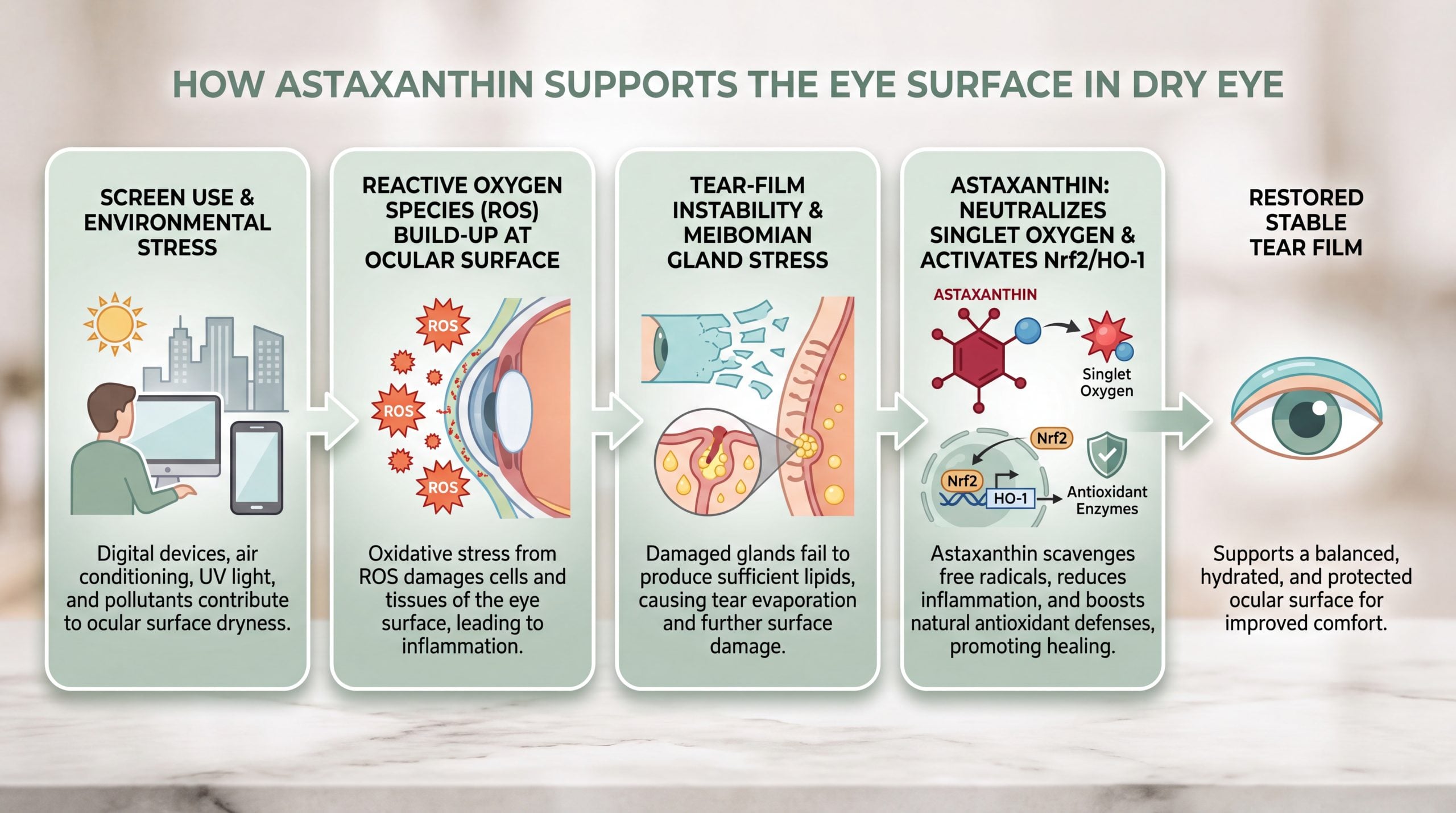
Oxidative stress occurs when there is an imbalance between harmful free radicals and the body’s ability to neutralize them. Within the eyes, this stress can lead to chronic inflammation, reduced tear quality, and discomfort. Insufficient tear film stability often creates a gritty sensation or sensitivity to light. Astaxanthin’s antioxidant capabilities have drawn attention to potentially reducing oxidative stress markers that play a role in dryness.
Astaxanthin’s Mechanisms of Action for Dry Eye Relief
Astaxanthin’s benefits for dry eyes extend beyond its general antioxidant properties. It operates through several specific mechanisms:
- Cell Membrane Protection: Astaxanthin’s unique molecular structure allows it to span the entire cell membrane, providing protection both inside and outside the cell. This is particularly important for the cells of the ocular surface, which are constantly exposed to environmental stressors.
- Anti-inflammatory Effects: Astaxanthin inhibits inflammation through multiple pathways, including the NF-kB pathway, a key regulator of inflammatory responses. Chronic inflammation is a major contributor to dry eye symptoms, so reducing inflammation is crucial for relief. A 2025 mechanistic study in Animal Models and Experimental Medicine (Liu et al., PMID: 40045550) reported that astaxanthin lowered inflammation and oxidative stress at the ocular surface by acting on the Keap1-Nrf2/HO-1 antioxidant pathway, and that it helped protect corneal epithelial cells under hyperosmotic stress. Full paper: doi.org/10.1002/ame2.70000.
- Improved Ocular Blood Flow: Studies suggest that astaxanthin can increase ocular blood flow velocity. This improved blood flow helps deliver nutrients to the eye tissues and remove waste products, contributing to overall ocular health and potentially reducing dryness.
- Enhanced Tear Film Stability: Astaxanthin may improve tear film stability by protecting the lipid layer of the tear film from oxidative damage. This lipid layer, produced by the meibomian glands, helps prevent tear evaporation. A 2022 study published in Frontiers of Nutrition showed that 12mg of astaxanthin daily significantly improved tear film stability and meibomian gland function in patients with mild-to-moderate dry eye disease.
- Corneal Protection: Astaxanthin has exhibited protective effects on the corneal epithelium, the outermost layer of the cornea.
Scientific Evidence Supporting Astaxanthin for Dry Eyes
Numerous studies have investigated the effects of astaxanthin on dry eye and related conditions. Here are some key findings:
Key clinical trials at a glance
| Study | Design and serving | What was measured | Observed result |
|---|---|---|---|
| Tian et al., 2022, Frontiers in Nutrition (PMID: 35096941) | Prospective study, 6 mg twice daily for 30 days, 60 adults with mild-to-moderate dry eye | Dry-eye symptom score (OSDI), tear break-up time, meibomian gland expressibility | Symptom and tear-quality measures improved over the study window |
| Hecht et al., 2025, Advances in Therapy (PMID: 40014233) | Randomized, double-blind, placebo-controlled, 4 mg daily for 84 days, children with digital eye strain | Tear production, computer-vision symptom score, visual fatigue | Tear production rose, and eye-strain scores fell versus placebo |
| Huang et al., 2016, Clinical Ophthalmology (PMID: 27274185) | Randomized, double-blind, placebo-controlled antioxidant formula containing astaxanthin, 8 weeks | Tear break-up time, Schirmer test, reactive oxygen species in tears | Tear break-up time and tear production improved and tear reactive oxygen species fell |
| Sources: doi.org/10.3389/fnut.2021.796951, doi.org/10.1007/s12325-025-03125-7, doi.org/10.2147/OPTH.S106455. Retrieved from PubMed. | |||
- Improved Tear Film Stability: As mentioned above, the 2022 Frontiers of Nutrition study demonstrated that 12mg of astaxanthin daily improved tear film stability and meibomian gland function. This is significant because tear film instability is a hallmark of dry eye.
- Reduced eye fatigue and better tear production: A 2025 randomized, double-blind, placebo-controlled trial in Advances in Therapy (Hecht et al., PMID: 40014233) gave 4 mg of astaxanthin daily for 84 days to young participants with heavy screen use. The astaxanthin group showed higher tear production and lower digital eye-strain scores than placebo. Some earlier accommodation research has also associated roughly 5 mg daily with improved focusing amplitude, which is relevant because eye strain and focusing difficulty often travel alongside dry-eye discomfort. Full paper: doi.org/10.1007/s12325-025-03125-7.
- Reduced Inflammation and Oxidative Stress Markers: Several studies have shown that astaxanthin can reduce markers of inflammation and oxidative stress in the eye. This is crucial because these factors contribute to the development and progression of dry eye.
- Improved Tear Breakup Time (TBUT): Studies have shown improvements in tear breakup time, a measure of how quickly tears evaporate from the eye’s surface. Shorter breakup times are associated with more severe dry eye, so an improvement in TBUT suggests a beneficial effect.
- Improvement in corneal fluorescence staining: Studies show astaxanthin can improve this.
Recommended Dosage
While there’s no universally agreed-upon dosage for dry eye specifically, research provides some guidelines:
- Mild to Moderate Dry Eye: 4-6 mg of astaxanthin per day is often recommended as a starting point. This dosage may be combined with other supplements, such as omega-3 fatty acids.
- More Severe Dry Eye: Some studies have used higher dosages, up to 12mg per day, to investigate potential benefits for tear film stability and meibomian gland function. It’s crucial to discuss higher dosages with a healthcare professional.
- General Eye Health Maintenance: 4mg per day is often suggested for general eye health support.
- Studies Showing Specific Benefits: 12mg per day: Shown to improve tear film stability (2022 Frontiers of Nutrition study). 5mg per day: Shown to improve accommodation amplitude in some studies.
It’s essential to remember that astaxanthin is fat-soluble. Taking it with a meal containing healthy fats (like avocado, nuts, or oil) enhances its absorption. Individuals taking omega-3 fatty acids or other lipid-based nutrients often take them together for convenience and potential synergistic benefits. Always consult with a healthcare professional to determine the best dosage for your individual needs.
Prefer a single-ingredient option you can measure yourself? Our astaxanthin powder, sourced from Haematococcus pluvialis microalgae, lets you dial in your own serving and take it with a fat-containing meal to support absorption. From our sourcing experience, single-origin algal astaxanthin gives you the clearest read on what you are actually taking.
Potential Side Effects and Considerations
While astaxanthin is generally considered safe for most individuals, it’s important to be aware of potential side effects:
- Allergic Reactions: Individuals with shellfish allergies should exercise caution, as astaxanthin can be derived from marine sources. While Haematococcus pluvialis (the primary source for supplements) is algae, cross-reactivity is possible.
- Digestive Issues: Mild gastrointestinal discomfort, such as bloating or diarrhea, may occur in some users.
- Red Stool Color: At higher doses, astaxanthin can cause a reddish discoloration of the stool. This is harmless but can be alarming if unexpected.
- Medication interactions: Astaxanthin may interact with certain medications. Because it can have a mild blood-pressure-lowering effect, it warrants care alongside blood-pressure medications, and it may also be relevant for people taking 5-alpha-reductase inhibitors. At higher servings, astaxanthin’s mild antioxidant and platelet-related activity could add to the effect of blood thinners such as anticoagulant or antiplatelet drugs, so extra caution is sensible there. People taking statins or other daily prescriptions should also check with their prescriber, since astaxanthin is fat-soluble and is taken with food. Always talk with your doctor before starting astaxanthin if you take any medication.
- Pregnancy and Breastfeeding: Due to limited research, it’s recommended to avoid astaxanthin supplementation during pregnancy and breastfeeding unless specifically advised by a healthcare professional.
In the broader safety literature, a 2024 systematic review of 59 studies in the European Journal of Pharmacology (Adiguzel and Ulger, PMID: 38843946) reported no significant adverse effects from astaxanthin supplementation across the studies reviewed. Individual responses still vary, so speak with your healthcare provider before adding any new supplement. Full paper: doi.org/10.1016/j.ejphar.2024.176706.
Comparing Astaxanthin to Other Eye Health Supplements
Several supplements are commonly used to support eye health, including:
Astaxanthin vs. Lutein/Zeaxanthin
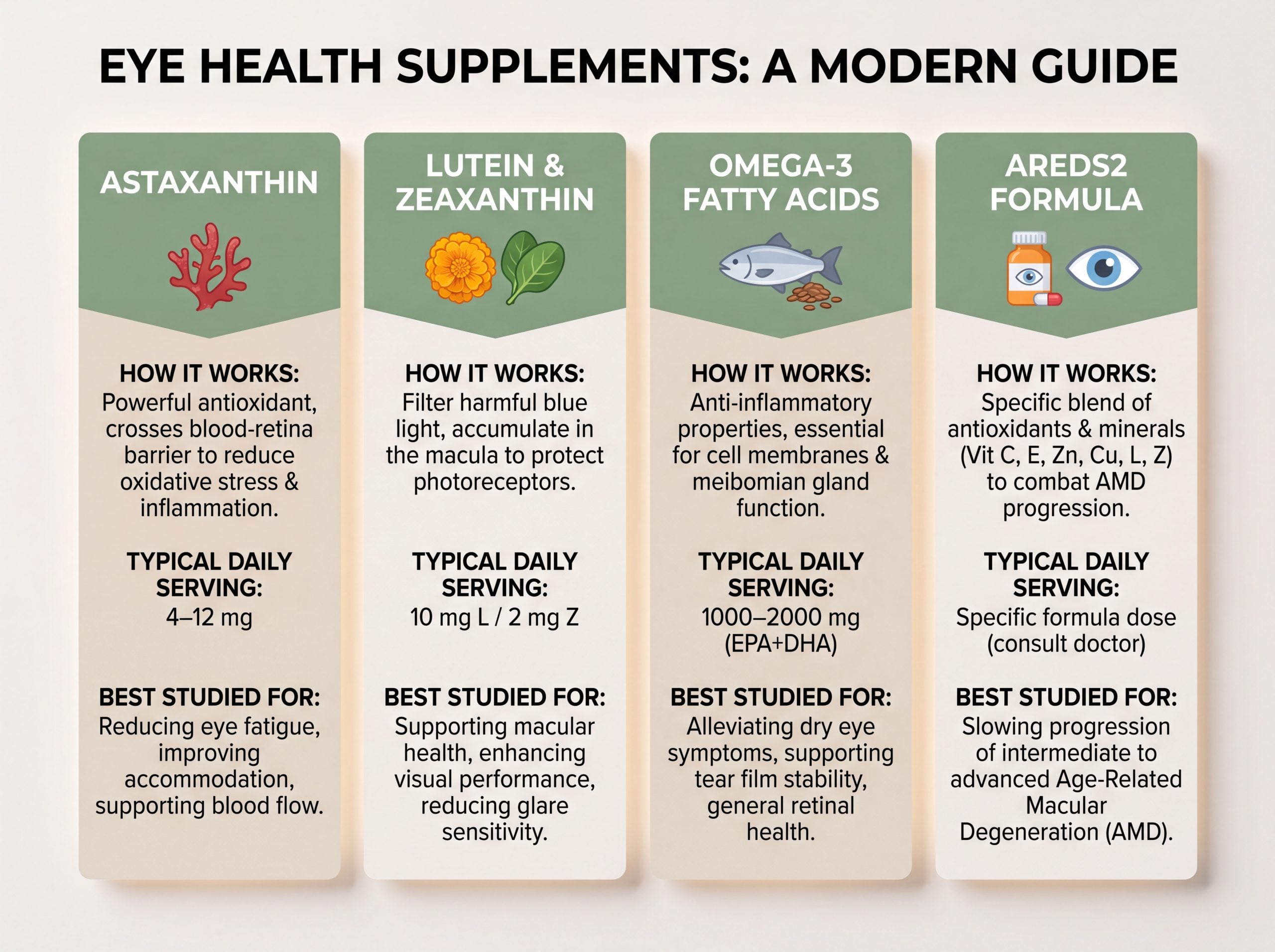
Lutein and zeaxanthin are primarily known for accumulating in the macula (the central part of the retina) and protecting against blue light and AMD. While astaxanthin also offers blue light protection, its broader antioxidant and anti-inflammatory effects may be more directly relevant to dry eye symptoms. Some individuals choose to combine astaxanthin with lutein and zeaxanthin for comprehensive eye health support.
Astaxanthin vs. Omega-3 Fatty Acids
Both astaxanthin and omega-3s have anti-inflammatory properties. Omega-3 fatty acids, particularly EPA and DHA, are well-known for improving tear quality and reducing dry eye symptoms. Astaxanthin may provide an added layer of antioxidant protection, particularly for the retina and ocular surface. Many people take both supplements together, under medical guidance.
Astaxanthin vs. AREDS2
AREDS2 supplements are specifically formulated to slow the progression of AMD. While they contain antioxidants that may indirectly benefit dry eye, their primary focus is on macular health. Astaxanthin is not a direct replacement for AREDS2 but could be considered as an additional supplement for individuals concerned about both AMD and dry eye.
Practical Tips for Managing Dry Eyes and Incorporating Astaxanthin
Astaxanthin should be part of a well-rounded approach to dry eye management, including:
- Regular Screen Breaks: Follow the 20-20-20 rule: every 20 minutes, look at an object 20 feet away for 20 seconds.
- Proper Lighting and Screen Positioning: Reduce glare and ensure your screen is positioned at a comfortable viewing angle.
- Blink Exercises: Consciously blink more frequently, especially during screen use.
- Humidifiers: Use a humidifier to add moisture to the air, particularly in dry environments.
- Hydration: Drink plenty of water to support overall hydration and tear production.
- Warm Compresses: Apply warm compresses to the eyelids to help improve meibomian gland function (if recommended by your eye doctor).
- Artificial Tears: Use lubricating eye drops as needed and in consultation with an eye doctor. There are many types of ophthalmic drops, so see a doctor for the right fit.
- Dietary Sources: While supplements provide a concentrated dose, you can also obtain astaxanthin from foods like wild-caught salmon, trout, and shrimp. However, the levels in these foods are generally lower than those found in supplements.
Frequently Asked Questions (FAQ)
Q1: How long does it take for astaxanthin to work for dry eyes?
A1: Some individuals may notice improvements within a few weeks, while others may require several months of consistent use. Factors such as the severity of dry eye, individual response, and overall health can influence the time it takes to see results. Studies have found some improvements around 2 weeks of use.
Q2: Can astaxanthin be combined with prescription eye drops for dry eyes?
A2: Yes, many people use astaxanthin alongside prescription treatments. However, it’s always essential to discuss any new supplements with your eye doctor or healthcare provider to avoid potential interactions.
Q3: Are there any dietary sources of astaxanthin that might help with dryness?
A3: Wild-caught salmon, trout, and shrimp contain astaxanthin, but the levels are generally lower than those found in concentrated supplements. Including these in a balanced diet may still provide some antioxidant benefits.
Q4: Do I need to cycle off astaxanthin periodically?
A4: There is no universal requirement to cycle off this supplement. Many experts suggest continuous use if it is well-tolerated. However, personal preference and healthcare advice should guide final decisions.
Q5: Does astaxanthin replace other dry eye measures like artificial tears?
A5: Haematococcus pluvialis extract is not a complete substitute for other measures. It can be a helpful addition to a regimen that includes lubricating drops, proper hydration, and environmental adjustments.
Q6: Can astaxanthin interact with my medications?
A6: Possibly. Astaxanthin has a mild blood-pressure-lowering effect and can be relevant alongside blood-pressure medications and 5-alpha-reductase inhibitors. At higher servings, it may also add to the effect of blood thinners such as anticoagulant or antiplatelet drugs, and people on statins or other daily prescriptions should check as well. Talk with your doctor before starting astaxanthin if you take any medication so they can review timing and serving size for you.
Q7: Is astaxanthin safe during pregnancy or breastfeeding?
A7: There’s not enough research to confirm safety. Avoid use unless advised by a doctor.
Q8: What is the best source of astaxanthin?
A8: Haematococcus pluvialis microalgae is considered the richest and most sustainable source.
Q9: What if I have retinopathy or another eye disease?
A9: See a doctor and discuss if astaxanthin is right for you.
In a world increasingly dominated by screens, maintaining optimal eye health is more important than ever.
Top Points to Consider When Choosing Astaxanthin Supplements
- Source: Look for supplements derived from natural sources, such as microalgae (Haematococcus pluvialis), to ensure quality and potency.
- Dosage: Pay attention to the dosage recommendations on the product label and consult with a healthcare provider for personalized advice. Common recommendations range from 4 to 12 mg per day.
- Formulation: Consider whether you prefer soft gels, capsules, or powder forms, and choose a formulation that fits your lifestyle.
- Brand Reputation: Research brands for quality assurance, third-party testing, and customer reviews to ensure you are purchasing a reputable product.
- Additional Ingredients: If you choose to use Astaxanthin with other ingredients, make sure to research each ingredient, such as glycol.
If you’re experiencing persistent dry eye symptoms, consult with your eye doctor or healthcare provider. They can help determine the underlying cause of your dryness and recommend the most appropriate treatment plan. This may include lifestyle modifications, artificial tears, prescription medications, or supplements like astaxanthin. Discuss whether astaxanthin, as part of a comprehensive approach, might be a suitable option for you.
These statements have not been evaluated by the Food and Drug Administration. This product is not intended to diagnose, treat, cure, or prevent any disease. Consult your healthcare provider before use.