Key Takeaways
- Jergon sacha is Dracontium loretense Krause, an Amazonian plant in the arum family (Araceae), and the part used is the underground corm rather than the leaf.
- Seven papers on the Dracontium genus are indexed in PubMed. All of them are laboratory or analytical work. No human clinical trial has been published.
- The best-documented finding is an oxylipin isolated from the corms that showed an immunostimulatory effect on human immune cells in a dish, not in people (PMID: 19341262).
- A venomous snakebite is a medical emergency that requires antivenom and immediate professional care. The Amazonian tradition around this plant does not change that.
- Araceae plants carry calcium oxalate crystals in raw tissue, which is why traditional preparation involves cooking or drying rather than eating the corm raw.
- When buying jergon sacha, verify the species, the plant part, the growing region, and whether a certificate of analysis exists for heavy metals.
Jergon sacha is one of the more misrepresented plants in the Amazonian herbal trade. Search for it, and you will find confident claims about snake venom, viruses, and detoxification, most of them repeated from the same handful of sources, almost none of them attached to a citation you can check.
Our editorial team went to the primary literature instead. There are exactly seven papers on the Dracontium genus indexed in PubMed as of August 2026. We read all of them. What follows is what they actually found, what Amazonian tradition actually records, and where the two are not the same thing. We have kept the traditional material because it is real ethnobotany worth documenting. We have also marked clearly where tradition runs ahead of evidence, because on this particular plant the gap is wide and, in the case of snakebite, dangerous to ignore.
This is a plant we source and sell. That makes the honest version more useful to you than the enthusiastic one.
What is jergon sacha?
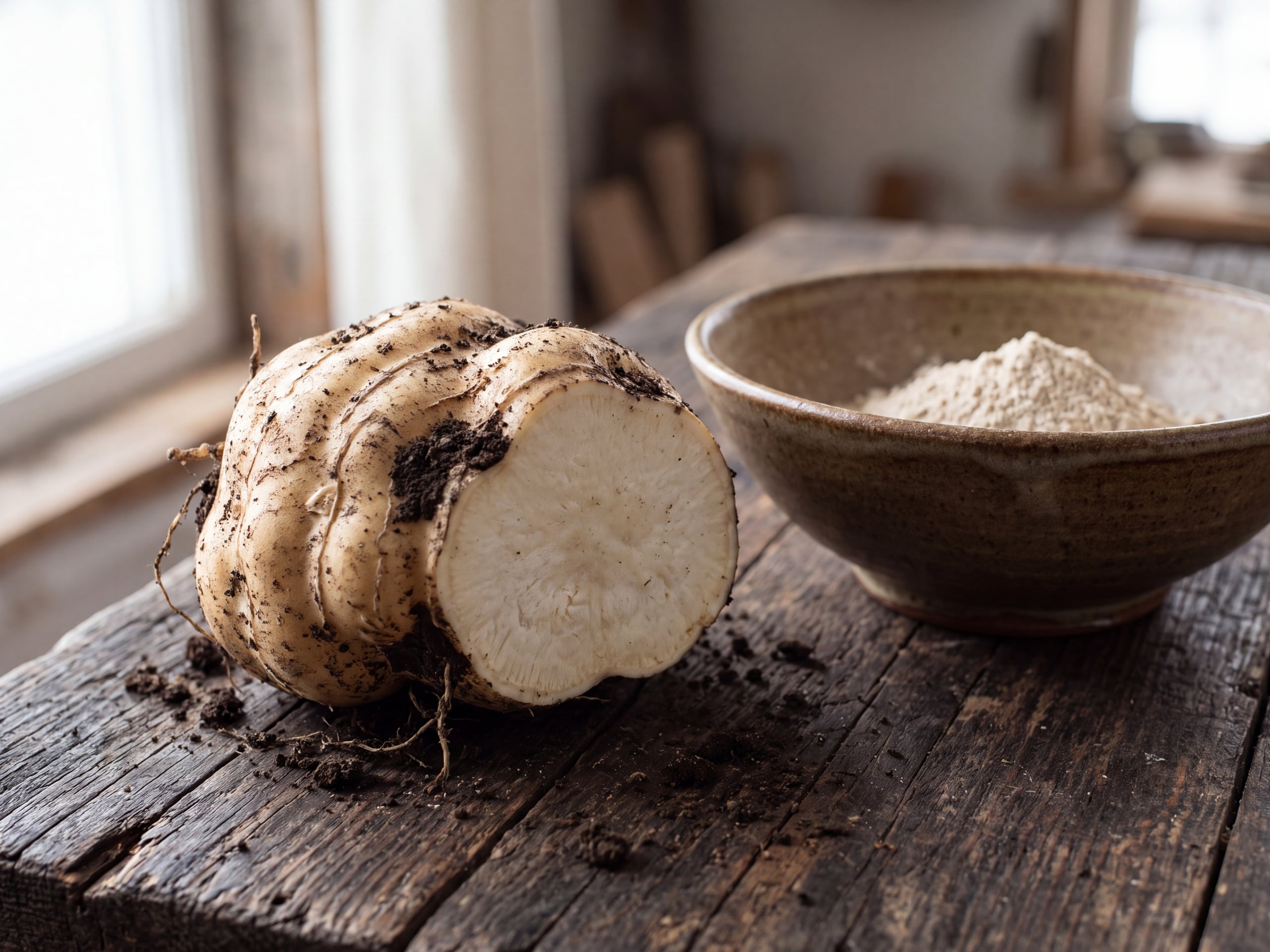
Jergon sacha is Dracontium loretense Krause, a perennial understory plant in the arum family (Araceae) native to the western Amazon basin, particularly the Loreto Region of northeastern Peru. The part used in traditional medicine and in commerce is the underground corm, a swollen storage stem. Chemical work on those corms has isolated four previously unknown oxylipins, one of which showed activity on human immune cells in laboratory conditions (Benavides et al., 2009, Journal of Natural Products, PMID: 19341262).
The plant sends up a single tall, mottled stalk that carries a large divided leaf. That stalk is the reason for the name. Its blotched grey-green-brown pattern resembles the skin of the jergon, the local name for the fer-de-lance pit viper (Bothrops atrox), one of the most medically significant snakes in the Amazon. Sacha means wild or false in Quechua. Jergon sacha is, roughly, false fer-de-lance.
Taxonomic records for the species are maintained by Kew’s Plants of the World Online. The genus Dracontium contains roughly two dozen accepted species across tropical Central and South America, which matters more than it might appear. See the species section below.
Which part of jergon sacha is actually used?
The corm. Not the leaf, not the stalk, and not what is loosely called the root.
This distinction gets blurred constantly in online descriptions, and it is worth being precise about because the published chemistry is corm chemistry. The 2009 oxylipin work used a butanol extract of the corms. The 2011 sphingolipid profiling that identified 21 ceramide and cerebroside species, 7 of them never previously reported, also worked from the underground tissue (Napolitano et al., 2011, Journal of Pharmaceutical and Biomedical Analysis, PMID: 21282027). When a description says “roots and leaves” without distinguishing them, that is a signal the writer has not looked at the source material.
In our sourcing work, corm-versus-leaf is one of the first questions we put to a supplier, because the two are not interchangeable and the price difference creates an incentive to blend.
Which Dracontium species is it?
Three species turn up under the jergon sacha name in different sources: Dracontium loretense, Dracontium longipes, and Dracontium spruceanum. Peruvian material sold as jergon sacha is most often D. loretense, and that is the species named in the oxylipin and sphingolipid work.
This is not a pedantic point. The most recent paper on the genus, a 2025 study on gastric cancer stem cells, used Dracontium spruceanum, a different species (Tapia-Rojas et al., 2025, Scientific Reports, PMID: 40866457). Any claim that borrows that paper’s findings and attaches them to D. loretense has crossed two lines at once: species and evidence tier. We address that study directly further down.
What does the peer-reviewed research on jergon sacha actually say?
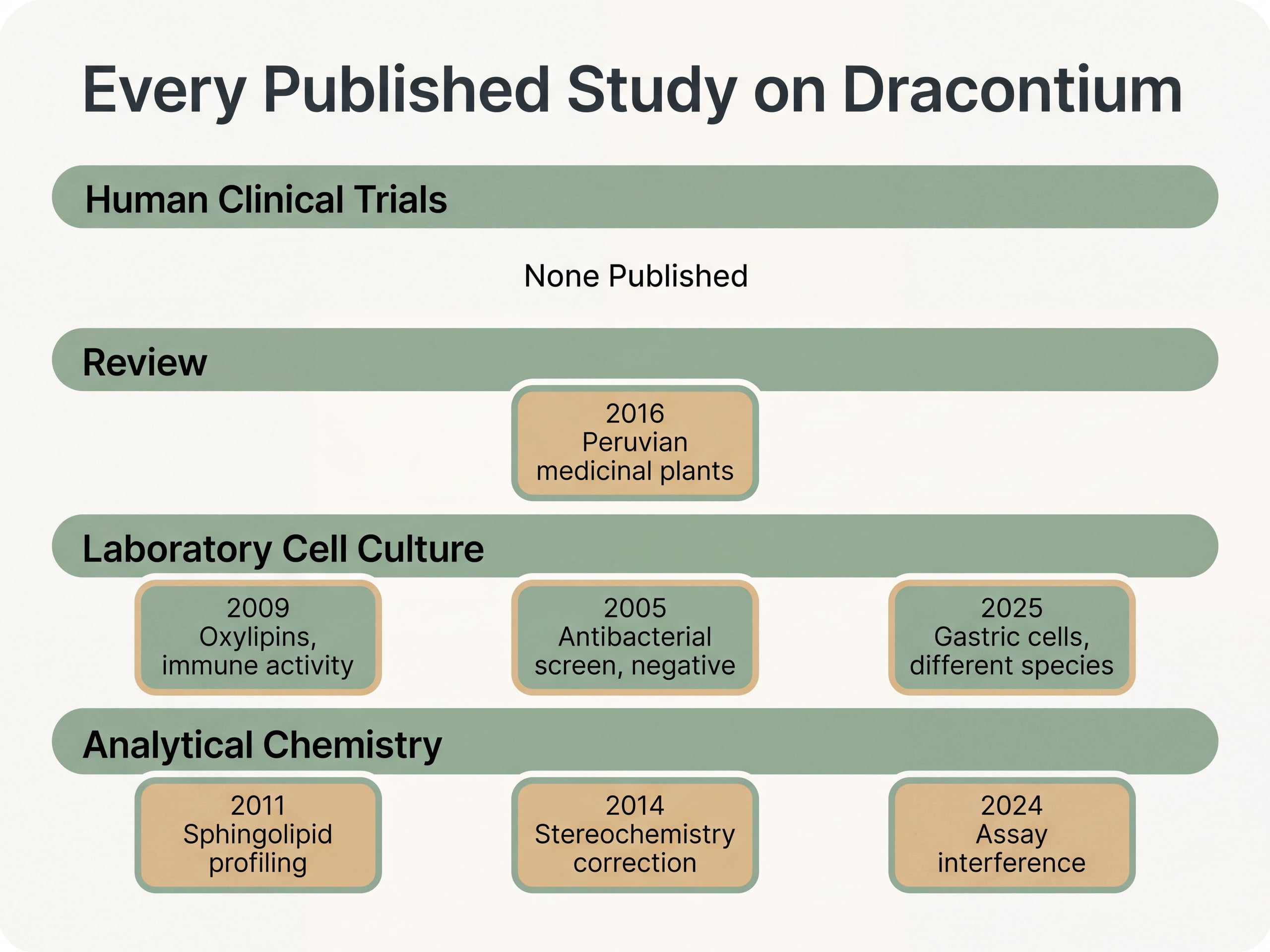
An oxylipin isolated from Dracontium loretense corms produced an immunostimulatory effect on human peripheral blood mononuclear cell proliferation in vitro, meaning in cultured cells rather than in a person (Benavides et al., 2009, Journal of Natural Products, PMID: 19341262). That is the single most cited finding on this plant. No human clinical trial on jergon sacha has been published in the indexed literature.
Here is the full set, with what each one is and is not.
| Study | Evidence tier | What it found |
|---|---|---|
| Benavides et al., 2009, J Nat Prod, PMID: 19341262 | Laboratory, cell culture | Four new oxylipins isolated from D. loretense corms. One of them affected human immune cell proliferation in a dish. |
| Napolitano et al., 2011, J Pharm Biomed Anal, PMID: 21282027 | Analytical chemistry | Identified 21 ceramide and cerebroside species in the plant, 7 of them previously unreported. Describes what is present, not what it does. |
| Abeykoon et al., 2014, Org Lett, PMID: 24918974 | Synthetic chemistry | Re-synthesized the 2009 oxylipins and found the original stereochemistry was assigned incorrectly. Corrected it to the anti configuration. |
| Kloucek et al., 2005, J Ethnopharmacol, PMID: 15894143 | Laboratory screen, negative result | Screened nine Peruvian plants for antibacterial activity. The active ones were Phyllanthus amarus and Terminalia catappa. D. loretense was not among them. |
| Lock et al., 2016, Nat Prod Commun, PMID: 27169179 | Review | Places jergon sacha among the twelve most-studied Peruvian medicinal plants. Summarizes existing work rather than adding new findings. |
| Tapia-Rojas et al., 2025, Sci Rep, PMID: 40866457 | Laboratory, cell culture, different species | A chloroform fraction of D. spruceanum altered gene expression in cultured gastric cancer stem cells. Not D. loretense, and not a treatment finding. |
| Tapia-Rojas et al., 2024, Saudi J Biol Sci, PMID: 38706720 | Methodological | Plant extracts glow under fluorescence and can distort lab readings. A caution about how to interpret the other studies. |
| Source: PubMed, searched August 2026. Seven records total for the genus. | ||
Two things stand out when you read these together. The first is that the 2014 correction is a small piece of scientific housekeeping that almost nobody repeats, and it is a good illustration of how early natural-product chemistry works. A structure gets proposed, someone else synthesizes it, and the assignment gets revised. The 2009 finding still stands. The stereochemistry attached to it changed.
The second is the 2005 antibacterial screen. It is a negative result for this plant, and we have never seen it cited on a page selling jergon sacha. We are including it because a source that only reports the flattering half of the literature is not a source worth trusting for the rest.
What about the protease inhibitor claim?
Several widely repeated descriptions state that jergon sacha contains natural protease inhibitors that act against viruses. We could not locate a peer-reviewed paper supporting that claim for Dracontium loretense in the indexed literature. It appears to have entered the herbal trade through secondary sources and been copied forward since. We are not able to substantiate it, so we do not repeat it.
What are jergon sacha’s traditional uses?
Traditional and historical use is well documented for this plant, and it is a separate category from clinical evidence. Amazonian ethnobotanical records describe the corm being prepared as a decoction, a poultice, or a dried powder, and applied across several categories of use.
- Bites and stings. The best-known traditional application, discussed in detail in the following section.
- Respiratory tradition. Preparations of the corm have historically been taken during periods of seasonal congestion and persistent cough. This use appears consistently across Peruvian ethnobotanical sources and is entirely absent from most English-language product descriptions.
- Topical application. The fresh juice or moistened powder has traditionally been applied to skin irritation, slow-healing sores, and insect-related lesions.
- General tonic use. In Loreto Region practice, jergon sacha sits among the household plants kept for periods of run-down health rather than for any single complaint.
Every item above is a record of what people have done with this plant. None of it is a statement that the plant does what tradition hoped it would do. That distinction runs through this entire article, and it is the honest position given that the clinical literature is empty.
Jergon sacha and snakebite: tradition versus emergency medicine
A venomous snakebite is a medical emergency. It requires antivenom and immediate professional care, and no herb, jergon sacha included, is a substitute for either. The Amazonian tradition linking this plant to snakebite is genuine, well-documented ethnobotany. It is not evidence that the plant neutralizes venom, and treating it as such costs lives.
We want to be direct about why this section exists. The snakebite story is the single most repeated thing said about jergon sacha, and it is usually told without the sentence above attached to it. In a region where Bothrops atrox envenomation is a real and time-sensitive medical event, that omission is not a marketing quibble.
The tradition itself is worth understanding on its own terms. Jergon sacha is a classic example of what ethnobotanists call the doctrine of signatures, the interpretive practice of reading a plant’s appearance as a clue to its use. The mottled stalk looks like the snake. The plant was therefore investigated for the snake. Amazonian practitioners have historically chopped or mashed the corm and applied it to the bite site as a poultice while also taking it internally, often while traveling toward help rather than instead of it.
That framing, tradition as a documented practice rather than a demonstrated mechanism, is how we treat it here and how we would encourage anyone writing about this plant to treat it.
What jergon sacha is not
Several claims circulate about this plant that the published record does not support. Naming them plainly is more useful than quietly leaving them out.
- It is not a cancer treatment. The 2025 gastric cancer stem cell paper (PMID: 40866457) is real, and it is worth reading, and it does not say what the internet will eventually say it says. It used Dracontium spruceanum, a different species from the one sold as jergon sacha. It was conducted in cultured cells. It measured changes in gene expression, not tumor outcomes. It involved no people. Nothing in it supports taking jergon sacha for cancer.
- It is not an antiviral. No indexed study demonstrates antiviral activity for Dracontium loretense. The claim is widespread and unsourced.
- It is not a treatment for HIV or serious infection. This claim appears in older herbal literature. There is no clinical evidence behind it, and anyone managing a serious infection needs medical care, not a botanical.
- It is not an antibacterial standout. When it was actually tested against nine bacterial strains in 2005, other plants in the same screen performed, and this one did not (PMID: 15894143).
- It is not a proven detoxifier. Detox is a marketing word rather than a physiological one. The liver and kidneys do that work. We have no evidence that jergon sacha changes how they do it.
Handling jergon sacha safely: the calcium oxalate question
Jergon sacha belongs to the Araceae, the arum family, and that family membership carries a specific handling consideration that most descriptions of this plant leave out entirely.
Raw Araceae tissue commonly contains calcium oxalate in the form of raphides, needle-shaped crystals that cause immediate burning and irritation of the mouth, throat, and skin on contact. This is the same family that includes taro, dumb cane, and philodendron, and it is the reason taro is never eaten raw. Traditional preparation of Araceae food and medicine plants across the tropics involves cooking, prolonged drying, or repeated washing, and those steps are not incidental to the tradition. They are the tradition.
The practical consequence: properly processed commercial jergon sacha powder, dried and milled from the corm, is a different material from a raw corm someone digs up and chews. Any preparation instruction that has you steeping raw plant tissue without addressing this is written by someone who has not thought about the botany. Our own quality process treats correct drying as a safety step, not just a shelf-life step.
What are jergon sacha’s side effects?
Established safety data for jergon sacha is thin, and that is the most important thing to say about it. There is no clinical safety trial, no established dosing range, and no long-term use data. What follows is drawn from traditional-use caution, from the plant’s family characteristics, and from general herbal safety practice.
| Consideration | Detail |
|---|---|
| Raw plant irritation | Calcium oxalate raphides in raw Araceae tissue can cause oral and skin irritation. Use properly dried and processed material. |
| Allergic response | As with any botanical, skin reaction or itching is possible. Discontinue use if it occurs. |
| Digestive tolerance | Larger amounts may cause digestive discomfort. Begin conservatively. |
| Medication interactions | The one documented laboratory activity is immune-related, so anyone on immunosuppressant or immune-modulating medication should speak with their prescriber first. |
| Pregnancy and nursing | No safety data exists. Avoid during pregnancy, nursing, and while trying to conceive. |
| Surgery | Discontinue well before any scheduled procedure and tell your surgical team what you have been taking. |
| Plant identification | Multiple Dracontium species and general Araceae confusion make correct sourcing a genuine safety factor, not just a quality one. |
How is jergon sacha traditionally prepared?
We do not publish dosing figures for jergon sacha, and we want to explain why rather than just leaving a gap. Specific amounts and frequencies imply a body of safety and efficacy data behind them. For this plant, that body does not exist. Numbers circulating online for jergon sacha are copied conventions, not findings. Follow the label on whatever product you have, and talk to a healthcare provider who knows your history.
What we can describe is the traditional preparation forms.
- Decoction. Dried corm material simmered rather than steeped. Simmering is the traditional method for dense underground plant parts across Amazonian practice.
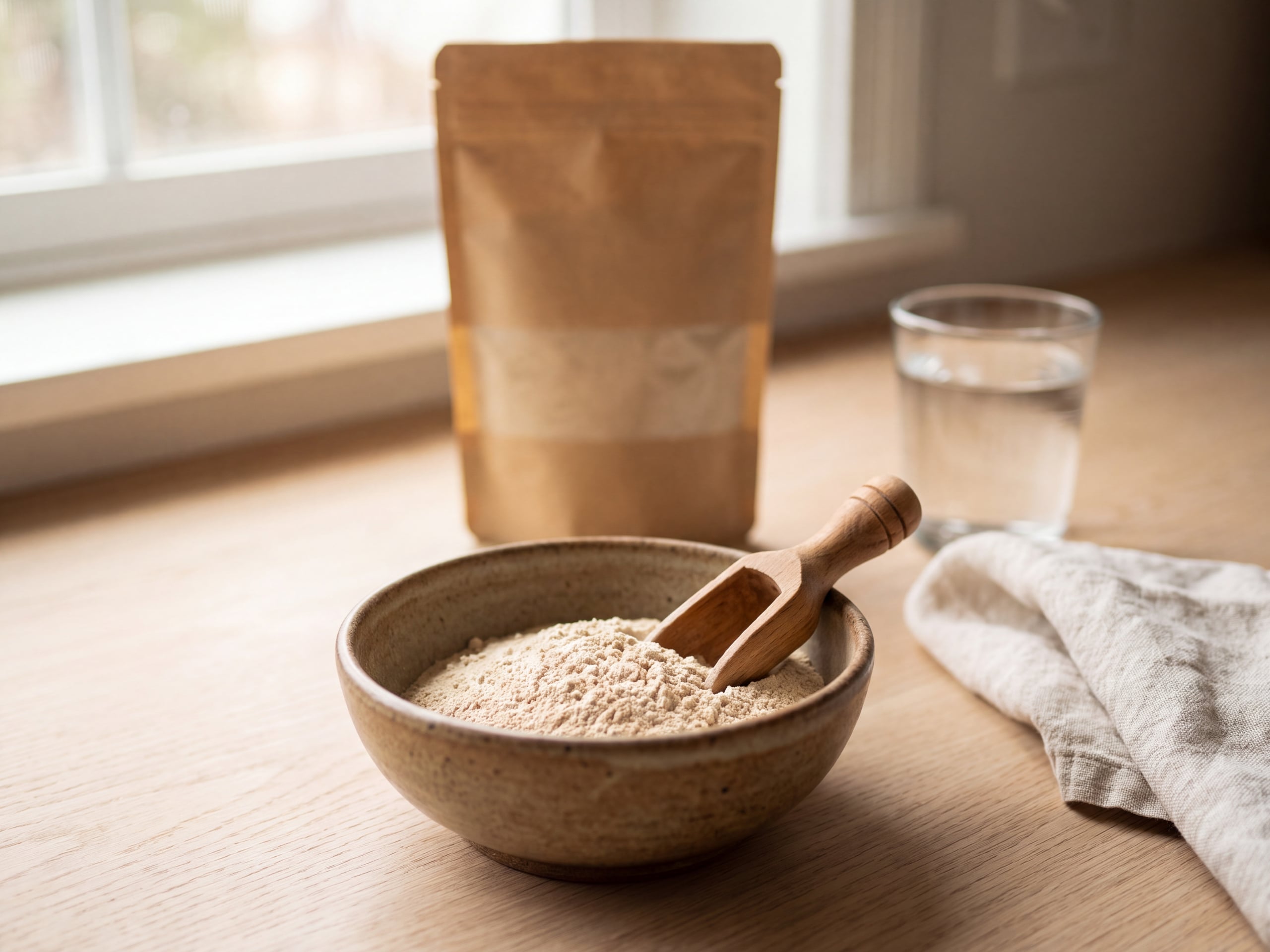
- Dried powder. The most common modern form. Milled from dried corm, stirred into water or a smoothie. The taste is earthy and starchy, closer to an unfamiliar root vegetable than to a bitter herb.
- Capsules. The same powder, measured. Chosen mostly by people who would rather not taste it.
- Topical preparation. Moistened powder applied externally, following the traditional poultice pattern.
Is jergon sacha combined with other herbs?
In regional Amazonian practice, jergon sacha is frequently discussed alongside cat’s claw, known locally as uña de gato (Uncaria tomentosa). The pairing shows up often enough in traditional accounts that it is worth naming as documented practice. What we cannot tell you is that the combination produces any particular effect, because nobody has studied it. Traditional co-occurrence is a fact about how people have used two plants together. It is not evidence that they work better together.
Jergon sacha in Amazonian spiritual and ethnobotanical practice
Jergon sacha carries a symbolic weight in Amazonian practice that its chemistry does not account for, and that symbolic role is a legitimate subject in its own right.
The plant is understood in Loreto Region tradition as a protective plant. Its logic is visual and analogical: a plant that wears the snake’s pattern is understood to hold some relationship to the snake, and by extension to danger, defense, and protection more broadly. Anthropologists call this reasoning the doctrine of signatures, and versions of it appear in traditional medical systems worldwide, from European herbalism to Traditional Chinese Medicine. In the Amazon it is a structuring principle rather than a curiosity.
Jergon sacha is also, in practical terms, one of the plants that marks the Loreto Region and the area around Iquitos as a distinct ethnobotanical zone, alongside cat’s claw, chuchuhuasi, and chanca piedra. These are the household plants of the Peruvian Amazon.
We describe this as belief and cultural practice, which is what it is. A plant’s spiritual role in a tradition is a real thing to document and a poor basis for a health decision. Both statements can be true at once.
How does jergon sacha compare to other Amazonian herbs?
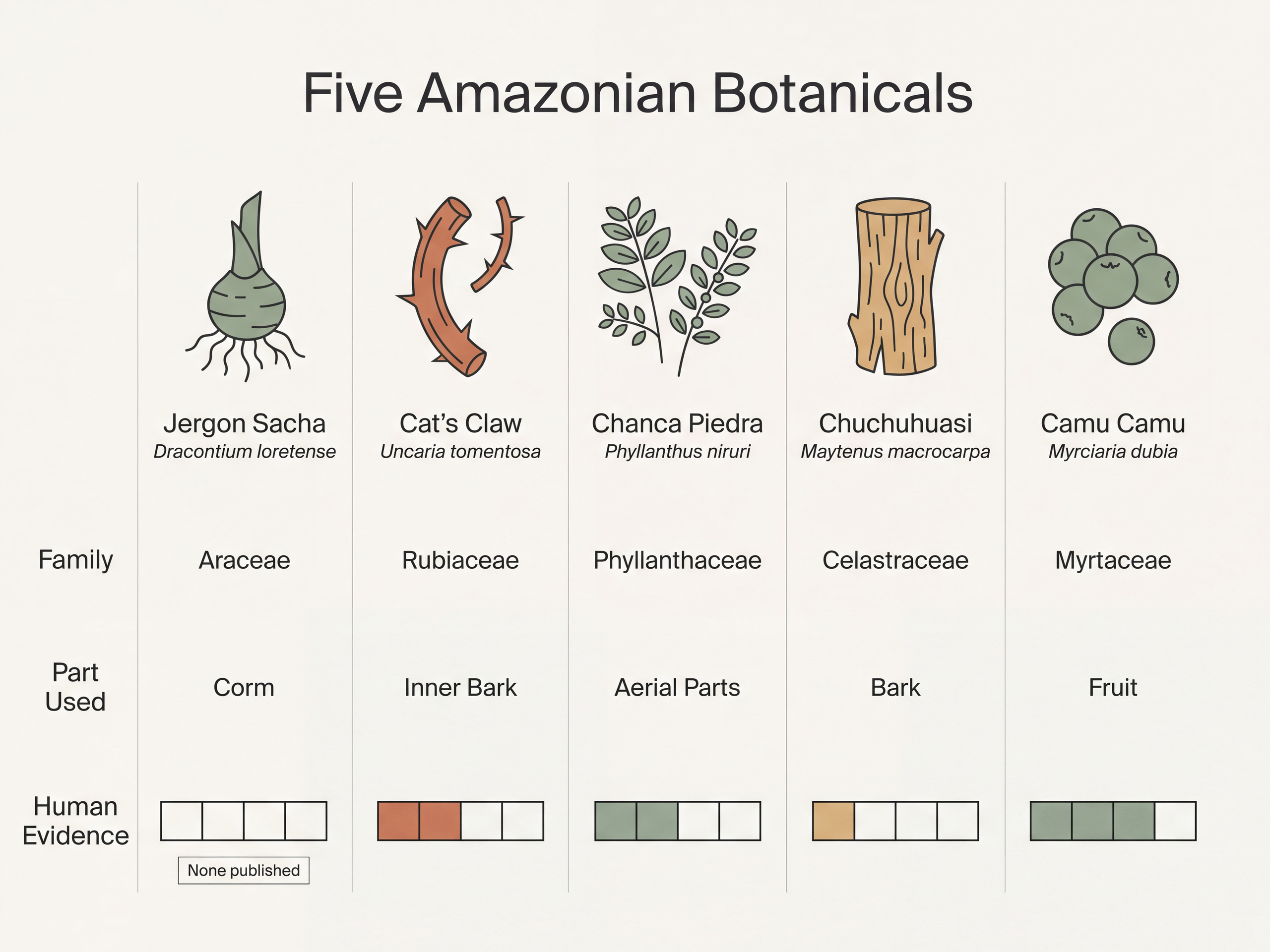
Jergon sacha is often shelved next to better-known Amazonian botanicals without much explanation of how they actually differ. They are not close relatives; they use different plant parts, and their evidence bases are not remotely equivalent.
| Plant | Botanical family | Part used | Traditional context | Published human clinical evidence |
|---|---|---|---|---|
| Jergon sacha (Dracontium loretense) | Araceae | Corm | Bites and stings, seasonal respiratory use, topical application | None published |
| Cat’s claw (Uncaria tomentosa) | Rubiaceae | Inner bark and root bark | Joint comfort, immune support | Small human trials published |
| Chanca piedra (Phyllanthus niruri) | Phyllanthaceae | Whole aerial plant | Urinary tract and kidney tradition | Some human studies published |
| Chuchuhuasi (Maytenus macrocarpa) | Celastraceae | Bark | Joint comfort, stamina, ceremonial use | Very limited |
| Camu camu (Myrciaria dubia) | Myrtaceae | Fruit | Nutritional, one of the densest natural vitamin C sources | Human studies published |
| Evidence column reflects the presence of published human research, not proof of effect. Several of these plants are reviewed in Lock et al., 2016, Nat Prod Commun, PMID: 27169179. | ||||
The last column is the one worth sitting with. Jergon sacha has the thinnest human evidence base of the five, and it is the one most often sold with the boldest claims attached. That inversion is common in the botanical trade, and it is worth recognizing when you see it.
Where to buy jergon sacha
Jergon sacha is a plant where sourcing quality is unusually hard to assess by eye, because dried, milled corm looks much like other dried, milled roots. A verification checklist is more useful than a recommendation.
- Species named on the label. Look for Dracontium loretense specifically. A label that only says jergon sacha has told you a common name shared by at least three species.
- Plant part stated. Corm or rhizome. If the label says leaf, or is silent, that is a real difference in what you are getting.
- Growing region. Peruvian Amazon, and ideally the Loreto Region. Region is a meaningful quality variable for wildcrafted material.
- Whole corm powder rather than an undefined extract. Extracts are fine when the ratio and solvent are disclosed. When they are not disclosed, whole powder is the more honest product.
- Heavy metal testing with a certificate of analysis. This applies to any wildcrafted root or underground plant part, which draws from soil. Ask whether a COA exists and whether you can see it.
- No fillers or flow agents. Check the ingredient panel for anything past the plant itself.
Our own jergon sacha powder and jergon sacha capsules are both wildcrafted Dracontium loretense corm from the Peruvian Amazon, and we keep the batch documentation available. The product pages carry the sourcing and specification details rather than repeating them here.
Frequently asked questions about jergon sacha
What is jergon sacha used for?
Traditionally, jergon sacha has been used in the Peruvian Amazon for bites and stings, for seasonal respiratory complaints, and topically for skin irritation and slow-healing sores. Those are records of traditional practice. No human clinical trial has tested any of these uses, so they should be understood as ethnobotanical history rather than demonstrated effects.
What are the benefits of jergon sacha?
The only laboratory-documented activity is immune-related: an oxylipin isolated from the corms affected human immune cell proliferation in cultured cells (PMID: 19341262). That is a finding in a dish, not a benefit demonstrated in people. Everything else attributed to this plant comes from traditional use rather than published research.
What part of the jergon sacha plant is used?
The underground corm, a swollen storage stem. The published chemistry, including the oxylipin and sphingolipid work, was all conducted on corm material. Descriptions referring to roots and leaves without distinguishing them are imprecise.
Does jergon sacha work for snakebite?
A venomous snakebite is a medical emergency requiring antivenom and immediate professional care. The traditional Amazonian association between jergon sacha and snakebite is well documented in ethnobotany. There is no clinical evidence that the plant neutralizes venom, and it must never be used in place of emergency treatment.
What are jergon sacha’s side effects?
No clinical safety data exists for this plant. Raw Araceae tissue can contain irritating calcium oxalate crystals, so properly dried material matters. Allergic response and digestive discomfort are possible. Avoid during pregnancy and nursing, and consult your prescriber if you take immune-modulating medication.
Is jergon sacha safe to take every day?
There is no established dosing range or long-term use data for jergon sacha, so we cannot answer that responsibly. Follow the manufacturer’s label and speak with a qualified healthcare provider who knows your health history and current medications.
What does jergon sacha mean spiritually?
In Loreto Region tradition, jergon sacha is regarded as a protective plant. Its snake-patterned stalk is read through the doctrine of signatures, the interpretive practice of treating a plant’s appearance as a clue to its role. This is a documented cultural belief rather than a physiological property.
Can jergon sacha be taken with cat’s claw?
Jergon sacha and cat’s claw (Uncaria tomentosa) are frequently discussed together in regional Amazonian practice. No research has examined the combination, so traditional co-occurrence should not be read as evidence that the two work better together. Anyone combining botanicals should raise it with a healthcare provider first.
Related reading
Continue with our guides to Uncaria tomentosa and the two cat’s claw species, chuchuhuasi spiritual benefits in Amazonian tradition, and the best herbs for the immune system.
Important: This article is for educational and informational purposes. The statements have not been evaluated by the Food and Drug Administration. The herbs and herbal products discussed are not intended to diagnose, treat, cure, or prevent any disease. Information presented here is not a substitute for professional medical advice, diagnosis, or treatment. Always consult a qualified healthcare provider for medical guidance specific to your circumstances. Do not delay seeking medical care because of information you have read on this site. A venomous snakebite is a medical emergency and requires immediate professional treatment.