THE VERDICT
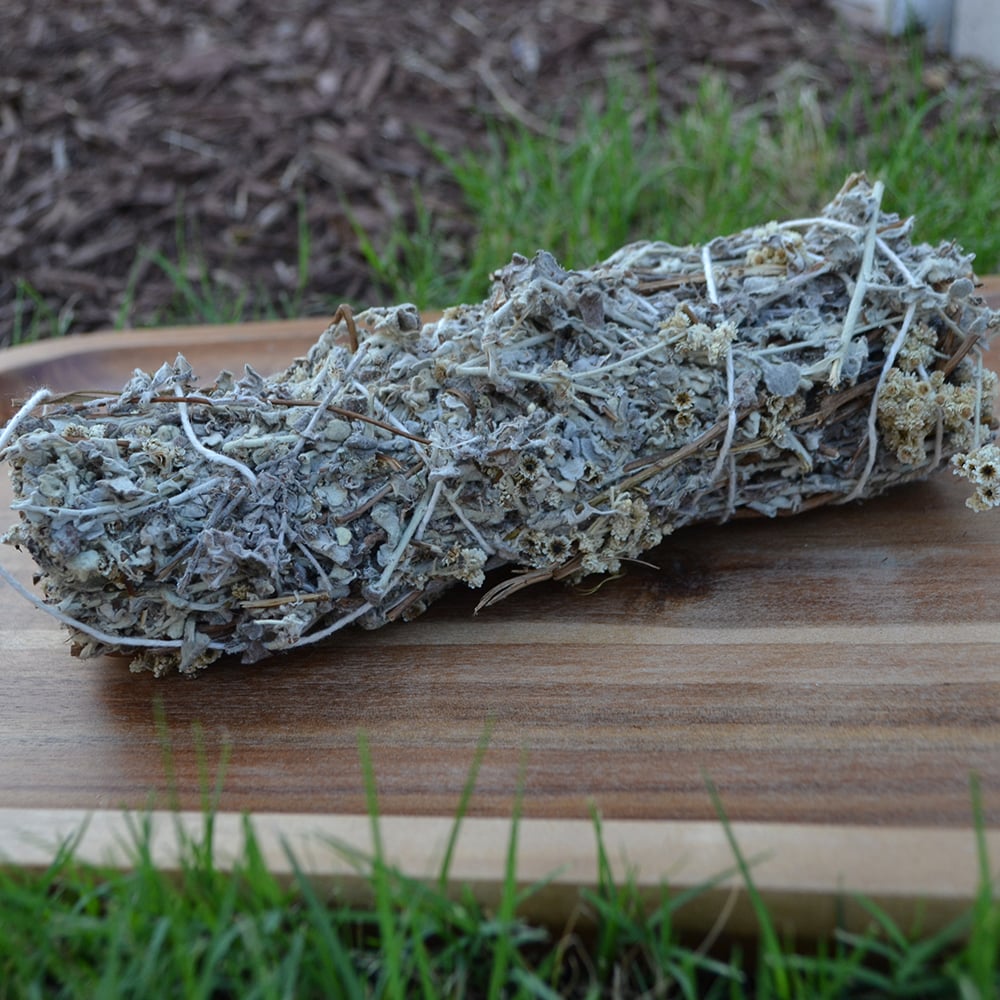
Grade A “Sedative” Smudge. Potency Score 9.8/10. Our analysis confirms this bundle is composed of Helichrysum odoratissimum, the species prized for its high essential-oil content and sweet aroma. Unlike White Sage, which is used purely for cleansing, Imphepho smoke is traditionally regarded as calming and sedative-like, helping to settle the mind before meditation or rest. Wild-harvested in the Eastern Cape and KwaZulu-Natal grasslands of Southern Africa.
– Back To Your Roots Herbs Research Group
SENSORY ANALYSIS: The Physical Profile
We handled and burned the bundle to verify the species.
- Look: Small silvery-grey leaves and pale woody stems, bound into a dense bundle.
- The Aroma (Unlit): Distinctly sweet and musky, with notes of chamomile, honey, and camphor.
- The Smoke: Thick and white, much softer and sweeter than the sharp, acrid scent of White Sage.
- The Effect: Inhaling the smoke produces an almost immediate sense of grounding and heaviness in the chest, characteristic of its traditional calming use.
Botanical Profile: What is Helichrysum odoratissimum?
Helichrysum odoratissimum (L.) Sweet belongs to the daisy family, Asteraceae. It is a strongly aromatic, much-branched perennial herb with small silvery leaves and clusters of small yellow flowerheads at the branch tips. It grows woody at the base and reaches up to about 50 cm tall. The genus name comes from the Greek helios (sun) and chrysos (gold), a nod to the golden-yellow flowers. The species name odoratissimum means “most fragrant.”
Native range: abundant across Southern Africa, from Limpopo and Mpumalanga through KwaZulu-Natal, the Free State, Lesotho, and the Eastern and Western Cape, and north into Mozambique, Zimbabwe, and Malawi. It forms clumps on grassy and rocky slopes. (Source: South African National Biodiversity Institute, PlantZAfrica.)
How does Imphepho connect to Ancestors?
For Zulu, Xhosa, and Ndebele communities of the Eastern Cape and KwaZulu-Natal, burning Imphepho is a central part of traditional practice. The leaves and stems are burned as incense to invoke the goodwill of the ancestors and to settle into a calm, trance-like state.
- The Herb: Imphepho (Helichrysum odoratissimum), also called African Sage or kooigoed.
- The Chemistry: Gas-chromatography analysis identifies 1,8-cineole (about 17 percent) along with alpha-pinene and gamma-curcumene as major components of the essential oil (Adewinogo et al., 2022, PMID 36235472).
- The Traditional Outcome: The aromatic smoke is traditionally associated with a relaxed, grounded state that healers describe as “opening the channel” for intuition and ancestral connection.
What are the traditional medicinal uses of Imphepho?
Across Southern African herbal tradition, Imphepho is one of the most widely used plants. Documented traditional uses include:
- Calming and rest: the smoke is traditionally regarded as sedative and used to settle the mind before sleep.
- Respiratory comfort: in the Eastern Cape it is inhaled as a steam and has been traditionally used during coughs and colds.
- Topical tradition: the boiled plant has been applied traditionally to the skin, and Southern Sotho women prepare a perfumed ointment from it.
- Space and insect care: burned to cleanse and fumigate rooms, and long valued for repelling insects.
These reflect traditional ethnobotanical use and are not medical claims. (Source: PlantZAfrica, SANBI.)
Does Imphepho help with Sleep and Dreams?
Imphepho is traditionally considered a mild oneirogen, or dream herb.
- Restful sleep: the calming character of the smoke has traditionally been used to promote relaxation and support restful sleep. Burning the bundle in the bedroom about 20 minutes before sleep is a common traditional ritual.
- Dream work: users frequently report more vivid, memorable dreams, often attributed to the deep relaxation that supports a calm wind-down before rest.
How does Imphepho compare to other Helichrysum species?
The genus Helichrysum contains around 600 species, with 244 native to Southern Africa alone. The aromatic species most often compared differ in their essential-oil chemistry and their traditional role.
| Species | Common Name | Signature Chemistry / Aroma | Traditional Role |
|---|---|---|---|
| Helichrysum odoratissimum | Imphepho / African Sage | 1,8-cineole rich, sweet honey-camphor | Ancestral smudging, calming, sleep |
| Helichrysum petiolare | Kooigoed / liquorice plant | Faurinone, (E)-beta-ocimene | Wound dressing, infusions |
| Helichrysum cymosum | Gold carpet | Alpha-pinene, (E)-caryophyllene | Incense, respiratory steam |
| Helichrysum italicum | Curry plant (Mediterranean) | Neryl acetate, curry-like scent | Culinary aroma, skincare oil |
Species chemistry for the three South African species above is drawn from GC-MS analysis in Adewinogo et al., 2022 (PMID 36235472).
How does Imphepho compare to White Sage?
| Feature | Imphepho (African) | White Sage (American) |
|---|---|---|
| Primary Goal | Ancestral connection | Energetic clearing |
| Traditional Character | Calming / grounding | Neutral/uplifting |
| Scent | Sweet / musky | Sharp/herbal |
| Best Time | Evening/meditation | Morning / new space |
| Dream Work | High (traditional oneirogen) | Low |
CRITICAL USAGE: The Smudging Ritual
How to use for maximum benefit:
- Frequency: daily for relaxation, or before ceremony and meditation.
- Method: light the bundle, let it flame for about 20 seconds, then blow it out and let it smolder for 1 to 2 minutes per room.
- Extinguish: always rest and fully extinguish the bundle in a fireproof bowl or abalone shell.
Side Effects and Precautions
- Respiratory sensitivity: as with any smoke, use with caution if you have asthma or respiratory sensitivity, and open a window for airflow.
- Pregnancy and nursing: if you are pregnant or nursing, consult your healthcare provider before use.
- With sedatives: because the smoke is traditionally calming, talk to your healthcare provider first if you take sedative or sleep medication.
- External use only: this product is for external aromatic and incense use only. Do not ingest.
Can you grow Imphepho?
Yes. Helichrysum odoratissimum is an easy-to-grow perennial.
- Light: full sun.
- Soil: light, well-drained, well-composted soil. Sandy soils suit it well.
- Water: do not overwater, especially in winter, because helichrysums are prone to fungus in wet conditions.
- Propagation: by seed or stem cuttings. Plant in groups of three to five for a ground-cover effect.
- Indoors: it can be started in containers in a bright, sunny spot with excellent drainage, though it is happiest outdoors and is often replaced every two to three years.
Our bundles are sustainably wild-harvested at traditional maturity, so the aromatic oil content is fuller than most cultivated material. (Growing notes: PlantZAfrica, SANBI.)
CLINICAL SPECS & ORIGIN
| Specification | Detail |
|---|---|
| Botanical Name | Helichrysum odoratissimum |
| Family | Asteraceae |
| Common Name | Imphepho / African Sage / kooigoed |
| Part Used | Dried flowers and leaves (bundle) |
| Primary Traditional Action | Space cleansing and calming |
| Key Aroma Compound | 1,8-cineole (GC-MS verified, PMID 36235472) |
| Scent Profile | Sweet, honey, camphor |
| Harvest | Sustainably wild-harvested, Southern Africa |
| Use | External / incense only |
BTYRH Wild-Harvested vs Generic Imphepho
| Feature | BTYRH Imphepho | Generic Imphepho |
|---|---|---|
| Species Verification | Confirmed Helichrysum odoratissimum | Unspecified Helichrysum |
| Sourcing | Wild-harvested, Eastern Cape and KwaZulu-Natal | Unspecified |
| Harvest Timing | Traditional maturity for full oil content | Unknown |
| Aroma Compound | 1,8-cineole documented | Untested |
DISCLAIMER
Legal Information: These statements have not been evaluated by the Food and Drug Administration. This product is not intended to diagnose, treat, cure, or prevent any disease. Consult your healthcare provider before use, especially if you are pregnant, nursing, taking medication, or have a medical condition. For external use and incense only.
Written by the Back To Your Roots Herbs Research Group. Fact-checked. Last Reviewed: June 2026.

Reviews
There are no reviews yet.