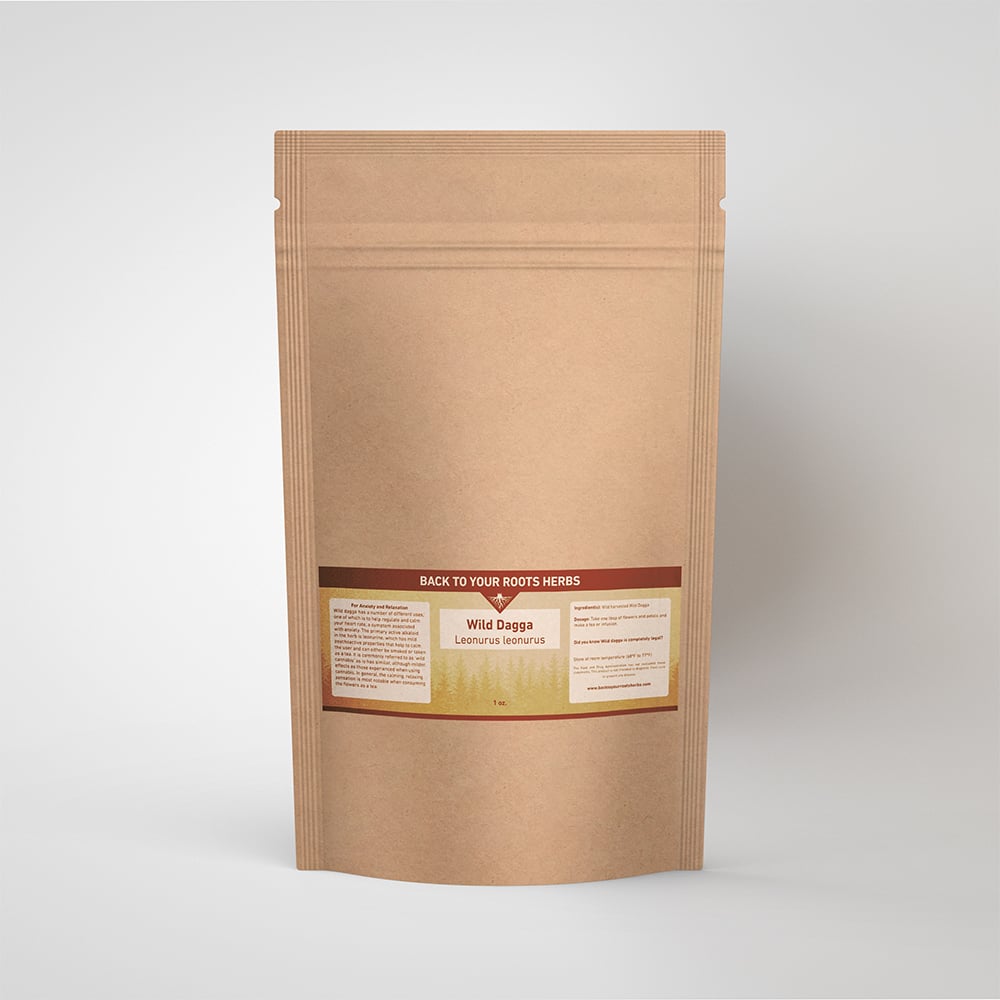
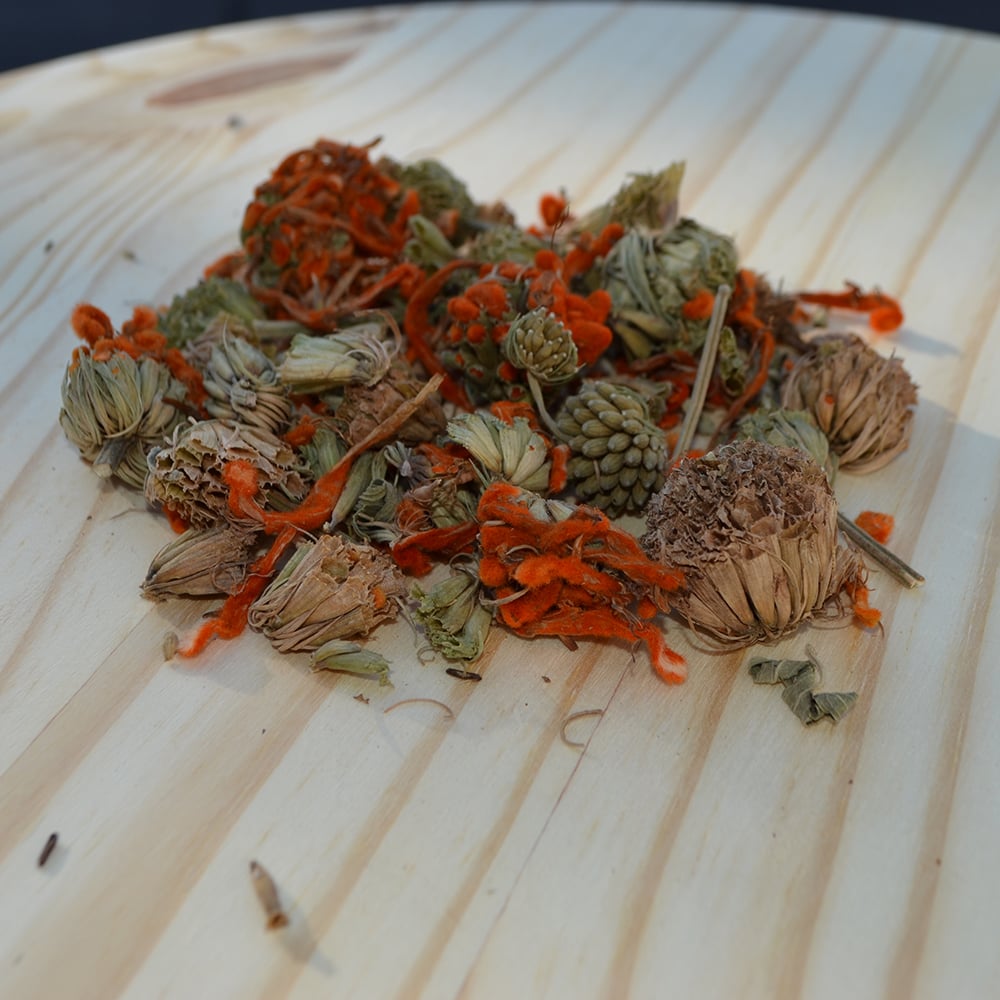
The Verdict on Wild Dagga Flowers (Internal Quality Score)
Grade A wild dagga flowers. Hand-picked petal heads from the Eastern Cape fynbos of South Africa. Bright coral hue, intact resinous bracts, aroma index above 8 of 10 on our internal cull. The terroir of dry highveld grasslands shows in petal density and resin content.
– Back To Your Roots Herbs Research Group
Sensory Analysis of Wild Dagga Flowers
- Look: Vivid coral to bright orange petal whorls, fine velvet hairs on the calyx, dry yet supple to the touch.
- Smell: Warm hay and mild honey on the open jar, a thread of citrus peel, finishing on faint tobacco-leaf sweetness.
- Taste: Earthy and gently bitter, finishing close to mullein and motherwort with a clean herbal aftertaste.
How Wild Dagga Flowers Work as a Botanical
The plant Leonotis leonurus, called lion’s tail by Cape herbalists and wild dagga in vernacular South Africa, is a flowering shrub in the Lamiaceae family. Leonotis grows wild across the Eastern Cape, the Karoo edges, and the Highveld. The wild dagga flowers in this lot were small-batch packed from sun-cured wild dagga flower heads.
The Herb and Its Origins
Leonotis leonurus is sourced from the Eastern Cape, South Africa (approximately 32.30 S, 26.42 E). Leonotis aerial parts, the petals, calyces, and seed-bearing whorls of the wild dagga plant, are the parts traditionally collected for tea, smoking blends, and apothecary use. Wild dagga is closely related to Leonotis nepetifolia, also known as klip dagga, but the two flowers are botanically distinct. Leonotis leonurus and Leonotis nepetifolia each carry their own dagga remedies tradition in southern African ethnobotany.
Wild Dagga in the Lamiaceae Family
The Lamiaceae family includes mints, sages, motherwort, and dozens of other aromatic herbs. Wild dagga shares this family with sage and mugwort, and the family signature shows in the squared stems and opposite leaves of the wild dagga plant. The Lamiaceae lineage is also why the wild dagga aroma reads as warm, herbal, and slightly resinous.
Etymology of Wild Dagga
The word “dagga” comes from the Khoikhoi language of southern Africa. In modern South African English, the term covers several unrelated calming herbs. Wild dagga flowers in the Leonotis genus are not related to cannabis. The naming is a vernacular overlap, not a botanical one.
Wild Dagga Flowers Phytochemistry
Wild dagga flowers’ phytochemistry is rich. The major labdane diterpene of Leonotis leonurus is marrubiin. Pharmacology and phytomedicine research has also identified eleven labdane diterpenes called leoleorins A through J, plus 16-epi-leoleorin F. The wild dagga extract profile includes flavonoids, volatile oils, and small amounts of essential oil class compounds. Wild dagga contains no THC, no cannabinoids, and no leonurine, the heart-active alkaloid found in Asian Leonurus species, which is often confused with this Leonotis flower.
Key Compounds in Wild Dagga Flowers
- Marrubiin: The signature labdane diterpene of Leonotis leonurus.
- Leoleorins A through J: Eleven labdane diterpenes isolated from Leonotis leaves.
- Flavonoids: Including luteolin glycosides shared with sage and mugwort.
- β-caryophyllene: A volatile oil terpene found in many Lamiaceae herbs.
The Evidence Base
Research by Wu and colleagues (2012) in Phytochemistry isolated three known plus eight new labdane diterpenoids from Leonotis leonurus leaves and tested binding at multiple CNS receptor sites in vitro. The full citation appears at the bottom of this page.
Critical Usage and Cautions for Wild Dagga Flowers
Suggested Use as Tea
One to two teaspoons of dried wild dagga flowers per 8 oz cup of just-boiled water. Steep covered for 5 to 10 minutes. Strain through a fine mesh. Honey, mint, or citrus peel pair well with the earthy floral profile of this herbal infusion. The wild dagga flower petals can also be added to apothecary tonics for sensory ritual.
Suggested Use in Herbal Blends
Some users include the petals in herbal smoking blends with mullein, sage, or calendula in place of tobacco. Wild dagga flowers also pair with motherwort, mugwort, and Artemisia vulgaris for tobacco-free blends and tea sets.
Wild Dagga Flowers Preparation Methods
- Tea: 1 to 2 tsp per cup, 5 to 10 minute steep.
- Herbal Blends: Pair with mullein, motherwort, mugwort, calendula, or sage.
- Sensory Ritual: Add the dry wild dagga blossom to apothecary jars and seasonal blends.
Storage and Shelf Life
Store the wild dagga flowers in a cool, dry place, sealed against light and humidity. The bright orange wild flower petals hold their aroma for 18 to 24 months in proper storage. Refrigeration is not required.
Negative Knowledge (Do Not Skip)
Not for use during pregnancy or breastfeeding. Do not combine with prescription medications without consulting a clinician familiar with herbal medicine and drug interactions. Discontinue if irritation occurs. Keep out of reach of children. Effects vary by user. The wild dagga benefits profile in folklore is mild and personal.
Wild Dagga Flowers Clinical Specs
| Spec | Detail |
|---|---|
| Serving Size | 1 to 2 tsp dried petals (approx. 1 to 2 g) |
| Frequency | Up to 2 cups per day, traditional preparation |
| Active Marker | Marrubiin, a labdane diterpene of the Lamiaceae family |
| Processing | Sun-cured whole flower petals, sieve-cleaned, no extraction |
| Safety | Heavy Metal Tested (Pass) |
| Ingredients | 100% Leonotis leonurus flower petals (Wild Dagga, Lion’s Tail) |
| Other Ingredients | None (Pure Loose Petals) |
| Purity | Non-GMO, Vegan, Wild-Harvested |
| Free From | Wheat, Gluten, Soy, Dairy, Binders, Fillers |
| Origin | Eastern Cape, South Africa (Specified Terroir) |
| Manufactured | Virginia Beach, VA, USA |
Specs Notes on Origin and Form
Why Eastern Cape Origin Matters
The Eastern Cape is the heart of the wild Leonotis leonurus range. Plants from this terroir produce denser orange petals, higher resin content, and a more layered aroma than greenhouse-grown stock.
Why Whole Petals, Not Extract
Whole sun-cured petals preserve the full Leonotis profile, including labdane diterpenes, flavonoids, and the volatile oils that define the wild dagga aroma. Extract concentrates one fraction at the cost of the others.
Wild Dagga Flowers vs. Generic Lion’s Tail Petals
| Feature | BTYRH Wild Dagga Flowers | Generic Lion’s Tail Petals |
|---|---|---|
| Origin | Eastern Cape, South Africa | Unspecified or greenhouse |
| Preparation | Whole sun-cured petals, no stem fillers | Stem-and-petal grind, often dust-heavy |
| Taste | Earthy floral, honey-tobacco finish | Flat or hay-only profile |
| Safety | Heavy Metal Tested (Pass) | Untested or unknown |
Wild Dagga vs. Klip Dagga
Wild dagga (Leonotis leonurus) and klip dagga (Leonotis nepetifolia) are sister species in the Lamiaceae family. Wild dagga has narrow lance-shaped leaves and bright orange tubular flowers. Klip dagga has heart-shaped leaves and paler orange flowers in tighter ball-shaped whorls. Both are part of the same African botanical family of medicinal plants and traditional medicine. The wild dagga blossom is denser in resin than the klip dagga blossom and is the wild dagga flower form most prized for tea and ritual.
Wild Dagga Flowers FAQ
Wild Dagga Flowers Quick Reference Questions
How do you brew wild dagga tea?
Steep 1 to 2 teaspoons of wild dagga flowers in 8 oz of hot water for 5 to 10 minutes. Strain. Sweeten with honey if desired. The earthy floral note pairs well with mint or citrus.
What does wild dagga tea taste like?
The taste is earthy and herbaceous, with mild floral sweetness and a clean bitter finish. The aroma reads close to dried hay with a touch of citrus zest.
Is wild dagga the same as cannabis?
No. Leonotis leonurus belongs to the Lamiaceae family. The cannabis plant belongs to the Cannabaceae family. Wild dagga contains no THC and no cannabinoids. Despite the shared word “dagga” in South African vernacular, the two flowers are botanically unrelated.
Is wild dagga legal in the United States?
Yes. Wild dagga (Leonotis leonurus) is legal to possess and cultivate in the United States. Always confirm your state and local regulations before purchase.
How do you use wild dagga flowers in herbal blends?
The petals blend smoothly with mullein, sage, calendula, mugwort, motherwort, and Artemisia vulgaris in tobacco-free smoking and tea blends. Wild dagga flowers also stand alone for solo brewing or apothecary infusions.
What do people report enjoying about wild dagga flowers?
Traditional South African folklore centers on calming evening rituals, herbal tea practice, and the sensory enjoyment of the bright wild flower itself. The reports are mild and personal, and effects vary by user.
Citation: Wu H, Li J, Fronczek FR, Ferreira D, Burandt CL Jr, Setola V, Roth BL, Zjawiony JK. Labdane diterpenoids from Leonotis leonurus. Phytochemistry, July 2013, 91:229-235. PMID: 22445074
DISCLAIMER: These statements have not been evaluated by the Food and Drug Administration. This product is not intended to diagnose, treat, cure, or prevent any disease. Consult a qualified healthcare provider before beginning any new herbal regimen. Not for use during pregnancy or while breastfeeding. Keep out of reach of children.
Reviews
There are no reviews yet.