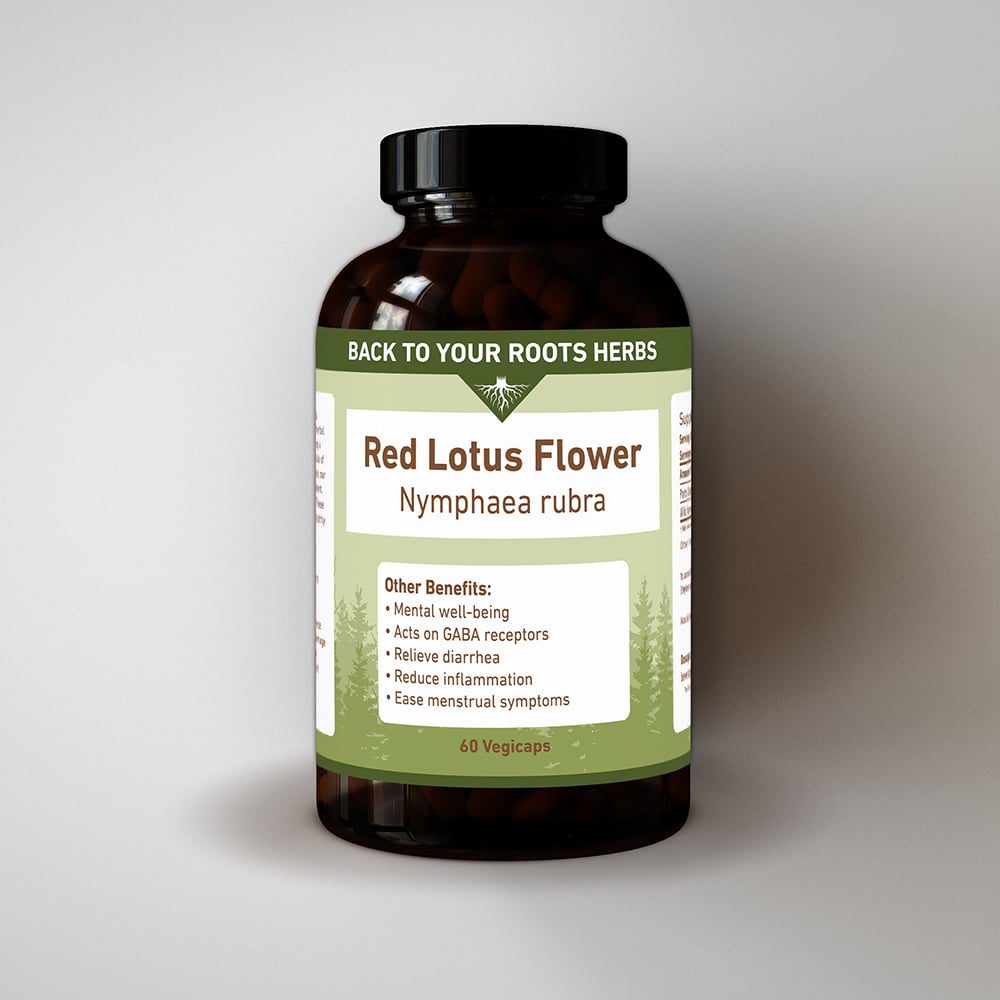
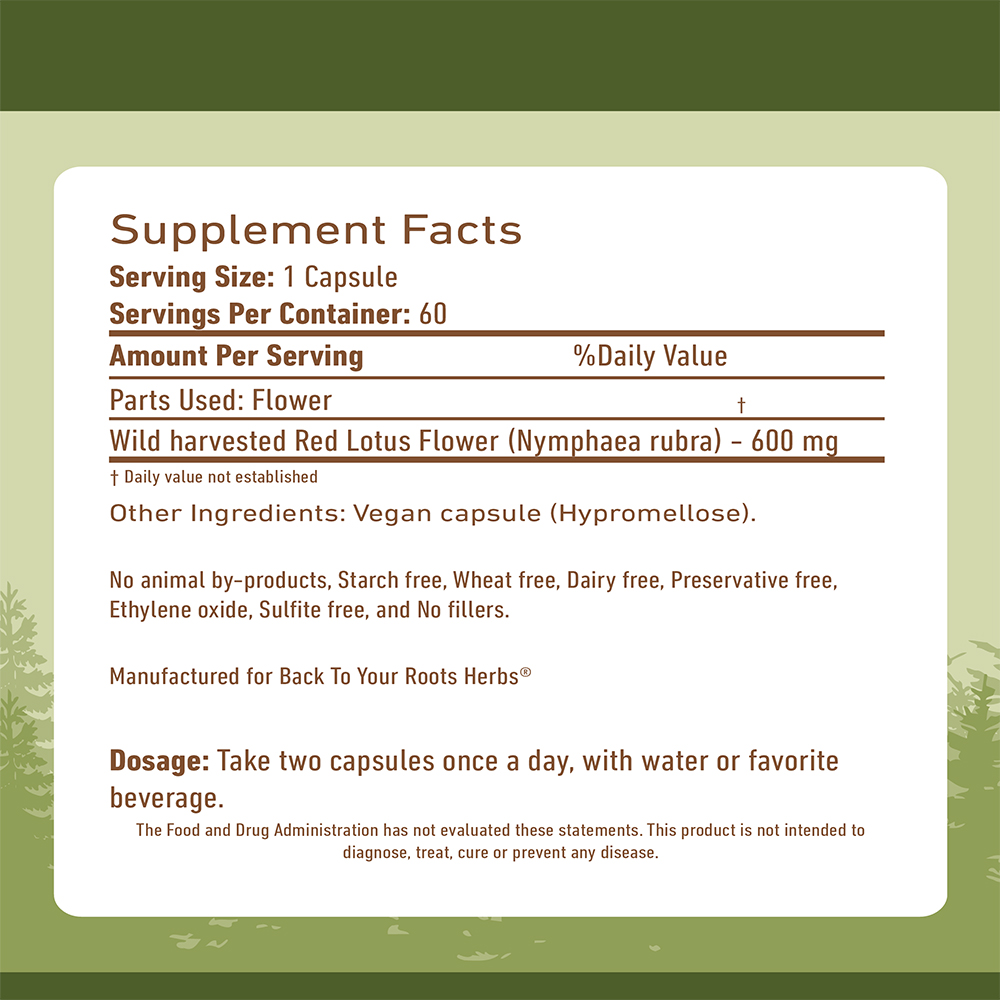
Experience a sense of tranquility with Red Lotus Capsules from Back To Your Roots Herbs. This herbal supplement is formulated for individuals seeking a natural way to support relaxation and a calm state of mind. Drawing from long-standing traditional use, our red lotus extract is prepared to provide a consistent, high-quality product for your wellness routine. These red lotus capsules are designed to integrate smoothly into a balanced lifestyle.
Key Takeaways
- Primary Support: Traditionally used to promote relaxation and a calm mental state.
- Botanical Source: Contains pure Red Lotus (Nymphaea rubra) flower extract.
- Active Compounds: Naturally contains aporphine alkaloids such as nuciferine, alongside antioxidant flavonoids.
- Antioxidant Properties: Nymphaea rubra contains natural compounds that help the body manage oxidative stress.
- Purity: Our capsules are made with all-natural Vegicaps and contain no fillers or artificial preservatives.
- Quality: Single-origin Thai petals, checked for purity and packed in Virginia Beach, USA.
What is Red Lotus?
Red Lotus, known botanically as Nymphaea rubra, is a species of water lily, not a true lotus (Nelumbo nucifera). This distinction is important for understanding its unique properties. The plant is characterized by its vibrant red or pinkish flowers and has been noted in various cultural traditions for its qualities. It is closely related to Blue Lotus (Nymphaea caerulea) and shares a similar profile of active compounds, which are responsible for its effects. Our extract is derived specifically from the petals of the Nymphaea rubra flower, the part of the plant most valued in herbal preparations.
Potential Benefits of Red Lotus Flower Extract
The compounds within the red lotus flower, chiefly the aporphine alkaloids nuciferine and apomorphine together with antioxidant flavonoids, are the basis for its traditional applications in natural remedies and herbal supplements. The science section below explains how these compounds are studied.
Support for Relaxation and Calm
Nymphaea rubra is most recognized for its calming effects. The natural compounds in the plant interact with the body in a way that may help soothe the nervous system. This makes it a suitable choice for use during meditation, before sleep, or at times when you need to unwind from daily pressures.
Natural Antioxidant Properties
The flower contains a variety of antioxidants. These substances help protect the body’s cells from damage caused by free radicals. By helping to neutralize these unstable molecules, the antioxidant content contributes to overall wellness.
Aid for Restful Sleep
Due to its relaxing characteristics, many individuals use red lotus extract to prepare for a night of restful sleep. By helping to quiet the mind, it can assist in creating the right conditions for falling asleep and maintaining a normal sleep cycle.
The Science Behind Red Lotus: Aporphine Alkaloids
The calming reputation of Nymphaea water lilies is most often attributed to a class of plant compounds called aporphine alkaloids. The two most discussed are nuciferine and apomorphine, supported by antioxidant flavonoids such as quercetin and kaempferol glycosides. Apomorphine is the aporphine most associated with Nymphaea caerulea and its close relative Nymphaea rubra, while nuciferine is shared across several lotus and water-lily species.
In preclinical research (laboratory and animal models), nuciferine has been characterized as a partial agonist at dopamine D2-family receptors with additional serotonergic activity, as reported by Farrell and colleagues (PMID 26963248). Follow-up pharmacokinetic work (PMID 30210336) found that nuciferine and its metabolite cross into brain tissue in rodents. Researchers propose this dopaminergic and serotonergic modulation as one possible basis for the gentle, mood-supporting calm that red lotus has traditionally been used for.
An honest note on the evidence. Much of the most rigorous sleep research on “lotus” was performed on Nelumbo nucifera, the sacred or culinary lotus, which is a botanically distinct plant from Nymphaea rubra. A rodent study reported that Nelumbo nucifera rhizome extract promoted sleep through GABA-A receptors (PMC9291699), and a human trial found that a Rhodiola rosea plus Nelumbo nucifera blend supported sleep quality (PMC11206944). We share these as related mechanistic context, not as studies on red lotus itself. For a professional reference on the lotus plant family, see the Memorial Sloan Kettering About Herbs database. The available data is largely preclinical, and red lotus capsules are a traditional botanical supplement rather than a treatment.
Red Lotus vs. Blue Lotus Capsules
Red Lotus and Blue Lotus are both true water lilies in the Nymphaea genus, and they share an overlapping aporphine-alkaloid profile. That is why they are often used for the same calming, pre-sleep purposes. The differences are subtle and largely a matter of personal experience.
| Feature | Red Lotus (Nymphaea rubra) | Blue Lotus (Nymphaea caerulea) |
|---|---|---|
| Botanical genus | Water lily, Nymphaea | Water lily, Nymphaea |
| Key compounds | Aporphine alkaloids (nuciferine, apomorphine), flavonoids | Aporphine alkaloids (apomorphine, nuciferine), flavonoids |
| Traditional use | Relaxation, calm, pre-sleep wind-down | Relaxation, calm, dream and mood support |
| Reported character | Soft, grounding, body-calming | Light, mood-lifting, dreamy |
To compare for yourself, see our Blue Lotus Capsules. If you prefer a loose form, we also offer Red Lotus Flower Powder.
Product Details and Composition
Our commitment is to transparency and quality. This natural food supplement is prepared with care to ensure you receive a pure and effective product.
| Attribute | Specification |
|---|---|
| Active Ingredient | Red Lotus (Nymphaea rubra) Flower Extract |
| Parts Used | Flower Petals |
| Origin | Thailand |
| Capsule Type | Vegetable Cellulose (Vegicaps) |
| Serving Size | 2 Capsules |
| Amount Per Serving | 900mg |
Our Quality and Sourcing
Every batch of our Red Lotus Capsules begins with Nymphaea rubra flowers, single-origin sourced from Thailand, where the species grows natively. We use only the petals, the part of the flower most valued in traditional preparation. The extract is encapsulated in all-natural Vegicaps with no fillers, binders, starch, or artificial preservatives, and each lot is checked for purity and consistency before it reaches you. Final packing takes place in Virginia Beach, Virginia.
How to Use Our Red Lotus Capsules
For best results, follow these clear guidelines for incorporating this supplement into your routine.
Recommended Use:
Take two (2) capsules once per day with water, or as directed by a healthcare professional. It is often taken approximately 30-60 minutes before bedtime or a relaxing activity. Do not exceed the recommended serving.
About Our Capsules:
The capsules are made from Vegicaps. They are all-natural and free from animal by-products, starch, wheat, dairy, preservatives, ethylene oxide, and sulfites, making them suitable for a wide range of dietary preferences.
Is Red Lotus Safe? Side Effects and Precautions
Red lotus is generally well-tolerated when used as directed. Because it has not been studied extensively in humans, a sensible and conservative approach is best.
- Start low. Begin with the lowest serving and assess your own sensitivity before continuing.
- Drowsiness. Because red lotus is used to support relaxation, avoid driving or operating machinery until you know how it affects you.
- Medication interactions. The aporphine alkaloids in Nymphaea show activity at dopamine receptors in laboratory studies. If you take sedatives, sleep medication, or dopaminergic or antipsychotic medications, speak with your healthcare provider before use.
- Pregnancy and breastfeeding. Not recommended, because safety has not been established.
Consult your healthcare provider before use, especially if you are pregnant, nursing, taking medication, or managing a health condition.
Is Red Lotus Legal in the United States?
Yes. Red Lotus (Nymphaea rubra) is not a federally scheduled or controlled substance in the United States, and it is sold openly as a botanical dietary supplement. Its close relative Blue Lotus (Nymphaea caerulea) is regulated in a small number of states, so it is wise to confirm the rules where you live. Our Red Lotus Capsules contain only Nymphaea rubra flower extract.
Storage and Shelf Life
Store Red Lotus Capsules in a cool, dry place, away from direct sunlight and humidity, with the lid tightly closed. Stored this way, the capsules retain their quality through the best-by date printed on the bottle, which is typically two years from the date of manufacture. Keep out of reach of children.
Frequently Asked Questions about Red Lotus
What are the main effects of red lotus?
The primary effects reported by users are a sense of relaxation, mental calmness, and support for restful sleep. It is not a sedative but rather promotes a state of tranquility.
Is red lotus the same as blue lotus?
They are closely related species within the Nymphaea genus and share similar active compounds and effects. Red Lotus (Nymphaea rubra) and Blue Lotus (Nymphaea caerulea) are often used for the same purposes, with some users noting subtle differences in their experiences.
Is red lotus psychoactive?
At the recommended servings, red lotus is not considered psychoactive. It does not produce a “high” but rather a gentle, calming effect that may help support a positive mood. The active compounds are mild in nature.
How is red lotus different from the lotus flower I see in food (Nelumbo nucifera)?
Nelumbo nucifera is the “sacred lotus” whose roots and seeds are commonly used in Asian cuisine. It belongs to a different botanical family and does not possess the same alkaloid profile or relaxing effects as Nymphaea rubra.
Does red lotus have side effects?
Red lotus is generally well-tolerated when used as directed. Because it supports relaxation, it may cause mild drowsiness, so avoid driving until you know how it affects you. Start with the lowest serving, and consult your healthcare provider if you take medication or are pregnant or nursing.
Is red lotus legal in the US?
Yes. Red Lotus (Nymphaea rubra) is not a federally controlled substance in the United States and is sold as a botanical dietary supplement. Check your local state rules, which can differ for the related blue lotus.
How should I store red lotus capsules?
Store them in a cool, dry place away from direct sunlight, with the lid tightly closed. Used this way, the capsules keep their quality through the best-by date on the bottle.
Can I take red lotus with other sleep supplements?
Many people pair calming botanicals, but combining red lotus with other sleep supplements such as valerian, magnesium, or melatonin, or with sedative medication, can increase drowsiness. Talk with your healthcare provider before stacking supplements.
Is red lotus habit-forming?
Red lotus is not known to be habit-forming at traditional serving sizes. As with any supplement, use it as directed and take breaks whenever you see fit.
Legal Information: These statements have not been evaluated by the Food and Drug Administration. This product is not intended to diagnose, treat, cure, or prevent any disease. Consult your healthcare provider before use.
Reviews
There are no reviews yet.