THE VERDICT (INTERNAL QUALITY SCORE):
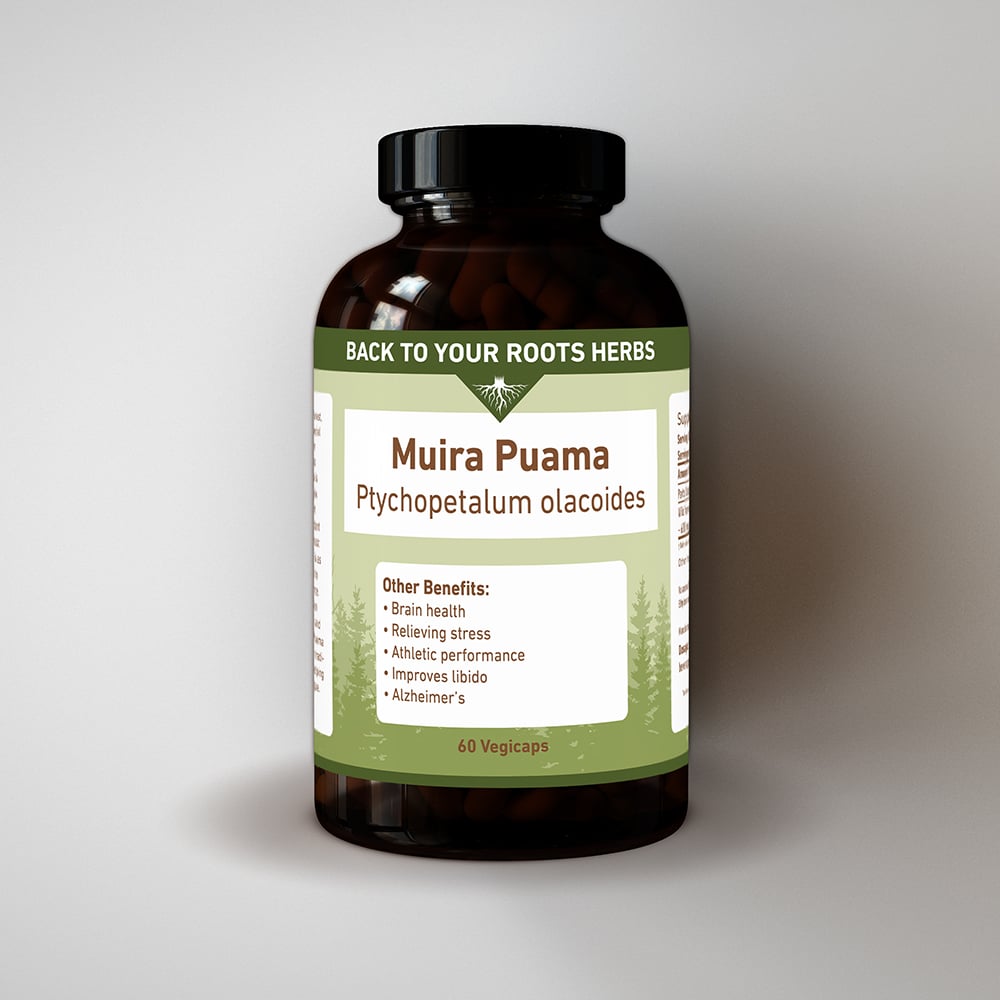
Grade A (Authentic). This lot of muira puama capsules is sourced strictly from the sandy blackwater soils of the Rio Negro Basin in the Brazilian Amazon. Authentic Ptychopetalum olacoides whole root and bark with the requisite saline-bitter chemotype often missing in generic Liriosma ovata substitute muira puama supplements. Identity confirmed by organoleptic tongue test, macroscopic fiber inspection, and third party heavy metal panel. High density of long-chain fatty acids, lupeol, and beta-sitosterol. Capsule shell is plant cellulose, no gelatin, no fillers, no binders.
– Back To Your Roots Herbs Research Group
Why This Grade Matters for Muira Puama Capsules
Most muira puama capsules on the commodity market (Horbaach, Swanson, GNC, Solaray, Nature’s Answer, PureFormulas, iHerb house brands, Kroger generic, Walmart Spring Valley, Amazon private label) do not disclose species or origin. We grade every incoming lot of muira puama before it becomes muira puama capsules. A Grade A lot of our Muira Puama supplements must pass species identity, sensory profile, heavy metal, and microbial testing. Anything less does not become a Muira Puama capsule here.
SENSORY ANALYSIS:
We cracked open a capsule from this lot of muira puama capsules to verify the botanical identity before release. First-hand report follows.
- Look: Pale sandy brown with reddish flecks. Fibrous and splintered, not powdered to silt. Clumps slightly under the natural oils native to the muira root. Individual strands of muira bark fiber are visible under magnification, consistent with cold stone-milled whole root and bark material.
- Smell: Dry lumber. Faint dusty earthiness. A whisper of something between old cedar and raw sweet potato skin. No grassy filler notes, no rancid oil notes, no synthetic perfume.
- Taste: Sharply saline on first contact with the tongue, almost like wet sea salt on wood. A hard, acrid bitterness follows and coats the back of the palate. A cool warming sensation lingers at the tongue tip for 30 to 60 seconds after. This saline-acrid-warming marker confirms real Ptychopetalum olacoides bark and root.
Muira Puama Capsules vs Substituted Puama Capsules
Generic muira puama supplements often use Liriosma ovata aerial parts or unrelated puama extract mixtures. Those capsules taste bland and woody with a papery finish. Our muira puama capsules taste saline and acrid with a warming finish. Tongue-check any bottle of puama capsules before trusting the label. A muira puama capsule that tastes like unsweetened oatmeal is probably not muira.
The Saline-Acrid Marker in Authentic Muira Puama Capsules
The distinct saline-acrid profile in real muira puama comes from the mineralization of the Rio Negro blackwater soil, plus the terpenoid and sterol content of the muira bark. When muira puama capsules lack this marker, the raw material is usually a puama extract blended with rice flour, a substituted muira species, or a spent muira tincture residue repackaged into capsules. Our muira puama supplements carry the marker because the material is whole root and bark, not an extract reconstitution.
HOW DOES MUIRA PUAMA WORK?
- The Herb: Ptychopetalum olacoides sourced from the Rio Negro Basin, Brazilian Amazon (0.19 S, 64.71 W). Family Olacaceae. Small understory tree. Ethically wild-harvested Muira root and bark, no aerial parts, no substituted species.
- The Mechanism: Sterols and long-chain fatty acids in the muira root act as an acetylcholinesterase (AChE) inhibitor in vitro. This enzymatic blockade supports increased acetylcholine availability relevant to the traditional Amazonian nerve tonic use of muira puama. The whole root and bark profile in our muira puama capsules preserves the co-factors that are lost when a puama extract is concentrated.
- The Evidence: Research by da Silva et al. (2004) documented memory retrieval improvement in mouse models dosed with Ptychopetalum olacoides extract (PMID 15507336). Siqueira et al. (2003) characterized the anticholinesterase activity profile of the same species (PMID 12895682). This research is referenced for context only and is not a product claim for these Muira Puama capsules.
Active Compounds in Our Muira Puama Capsules
Each 500mg capsule delivers whole muira root and bark containing lupeol, beta-sitosterol, campesterol, behenic acid, lignoceric acid, traces of coumarin, and Amazonian lignans. No puama extract concentration is used because concentration removes the fatty acid matrix that the sterols ride in on. The full chemical profile of the muira plant is preserved inside veggie capsules, including the muira tincture-adjacent lipophilic constituents that a hot water puama extract would strip out.
Traditional Amazonian Use of Muira Puama Capsules
Historically, muira puama was prepared as a bark decoction, a bark tincture, or a chewed root slice. Modern muira puama capsules carry the same whole plant material into a shelf-stable veggie capsule. Amazonian practitioners used muira puama for morning clarity, nerve recovery after physical labor, and the vitality-adjacent context that Western herbal supplements markets later grouped with libido botanicals. These Muira Puama capsules retain that whole plant framing.
Entity Reference: Tradition and Tribe Use
Amazonian tribe elders classified muira puama as a nerve tonic, a vitality botanical, and a morning clarity herb. The muira puama plant was chewed raw on fatigue days and decocted on recovery days. Western herbal supplements traditions adopted muira puama capsules in the twentieth century alongside catuaba, eleuthero (Siberian ginseng), ashwagandha, maca, tongkat ali, tribulus, saw palmetto, and horny goat weed.
Muira Puama Capsules Among Other Adaptogenic Herbal Supplements
Muira puama capsules occupy a specific niche in the herbal supplements category. Unlike ashwagandha, which is calming, muira puama supplements are gently stimulating. Unlike maca, which is nutritive and carbohydrate-rich, muira capsules are lipophilic and sterol-rich. Unlike horny goat weed, which carries strong flavonoid activity, muira puama works through fatty acid and sterol cofactors. Unlike catuaba, which tastes sweet and bitter, muira puama tastes saline and acrid. People who stack muira puama capsules with catuaba, tongkat ali, or tribulus typically do so for complementary rather than redundant action.
Muira Puama Capsules for Energy and Daily Vitality
Amazonian practice valued muira puama as a morning clarity and energy herb, chewed raw on fatigue days before physical labor. Our muira puama capsules carry that same whole root and bark into a daily format. The gently stimulating profile of muira puama supplements is traditionally used to support everyday energy and a sense of morning vitality, which is why the standard serving is taken in the AM rather than at night. This is a traditional structure and function context from Amazonian use, not a claim that muira puama capsules raise energy in any measured clinical sense. People who prefer a loose powder format instead of capsules often choose muira puama powder, which delivers the same whole root and bark.
Muira Puama, Circulation, and Traditional Aphrodisiac Use
Western herbal supplements markets historically grouped muira puama with libido botanicals, and Amazonian practice classified the muira root as an aphrodisiac tonic. Preliminary laboratory research has examined how muira puama and related botanicals interact with the nitric oxide and cyclic GMP pathway in penile smooth muscle tissue. This work is mechanistic and was conducted in animal and cell models (PMID 29551532, PMID 26405615), not in human clinical trials of muira puama capsules. The honest framing is this. Muira puama capsules are traditionally used as an aphrodisiac and circulation tonic. They are not a treatment for erectile dysfunction, and the human evidence for the herb taken alone is limited. People exploring this traditional category often compare muira puama with horny goat weed, tribulus, and damiana.
CRITICAL USAGE:
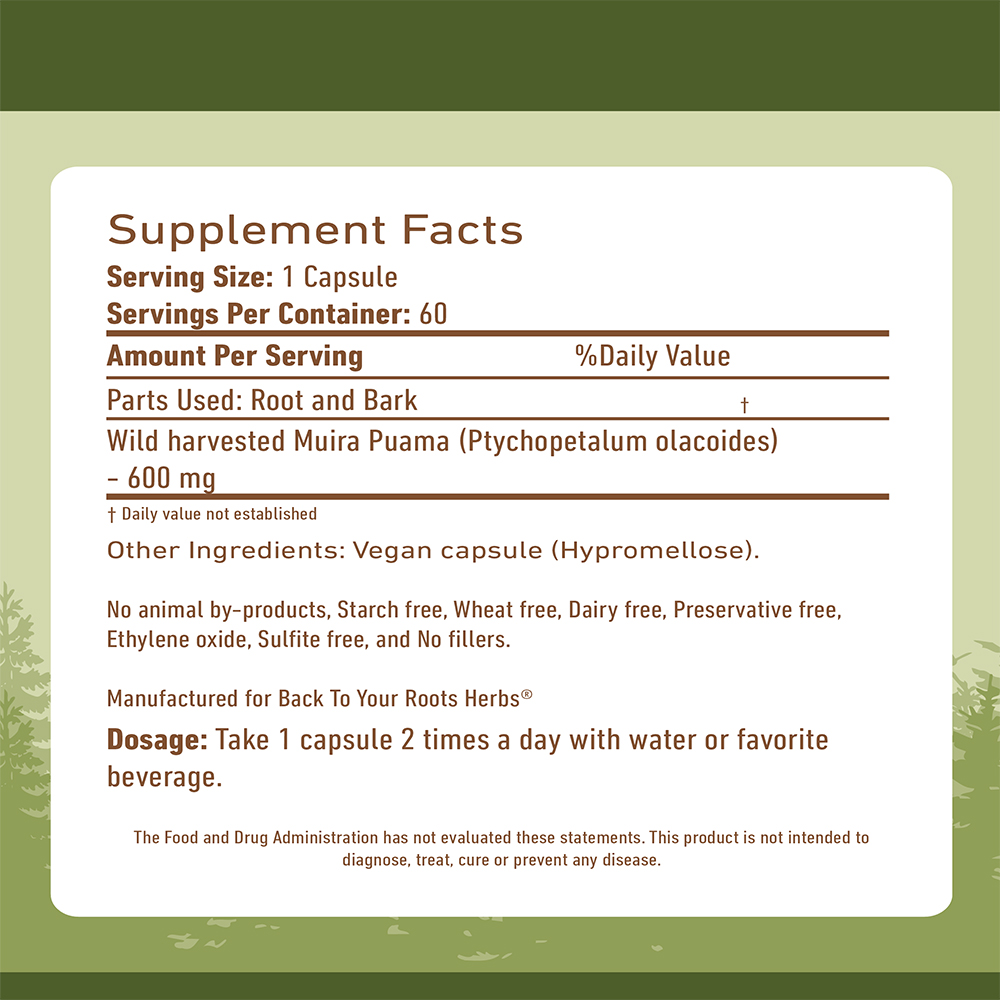
Dosage: Take 2 muira puama capsules daily (1000mg total muira puama whole root and bark). Best in the AM with 8 to 12 oz of water. The gentle stimulating profile of muira puama supplements may interfere with sleep if taken in the late afternoon or evening. Do not exceed 4 capsules (2000mg) in a 24-hour window. Capsules may be taken with or without food, though a small amount of fat (nut butter, whole milk yogurt, eggs) can improve absorption of the lipophilic sterols native to the muira root.
Contraindications: Do not use during pregnancy or lactation. The sterols in muira may influence hormonal signaling. Consult a physician before combining muira puama capsules with AChE inhibitor drugs, blood pressure medication, blood thinners, hormone replacement therapy, or any other prescription drugs. Keep Muira Puama capsules out of reach of children. Discontinue muira puama supplements if unexpected heart palpitations, insomnia, restlessness, or digestive discomfort appear.
Dosage Guidelines for Muira Puama Capsules
Start with 1 muira puama capsule for the first 3 days to assess individual response. Escalate to 2 capsules daily as the standard serving. Some users of muira puama supplements report best results at 2 capsules in the AM with a second 1 capsule dose at lunch. This AM-PM split mimics the historical Amazonian pattern of a morning decoction and a mid-day reinforcement. The total daily ceiling remains 4 muira puama capsules.
Contraindications and Drug Interactions
Pregnancy and lactation are hard contraindications for muira puama capsules. Individuals on anticholinergic medication, cholinesterase inhibitor drugs (for example, donepezil, rivastigmine, galantamine), MAO inhibitors, SSRIs, or blood pressure drugs should consult a qualified health provider before starting muira puama capsules. The lipophilic sterols in muira may also influence the absorption curve of fat-soluble drugs.
Side Effects of Muira Puama Supplements
Reported side effects of muira puama supplements at normal dosage are rare. The most common are mild gastrointestinal discomfort in the first week of use, light sleep onset disturbance when taken past 2 pm, and infrequent transient headache. These typically resolve within 5 to 7 days of consistent morning use. Discontinue the muira puama capsules and consult a physician if side effects persist.
CLINICAL SPECS:
| Spec | Detail |
|---|---|
| Serving Size | 2 Capsules (1000mg muira puama whole root and bark) |
| Frequency | Daily (AM with water) |
| Active Marker | Lupeol, Beta-Sitosterol, Behenic Acid, Long-Chain Fatty Acids |
| Processing | Sun-Dried Muira Root and Bark, Cold Stone-Milled (no solvent extract) |
| Safety | Heavy Metal Tested (Pass) |
| Ingredients | 100% Ptychopetalum olacoides Whole Root and Bark Powder |
| Other Ingredients | Vegetable Cellulose (Veggie Capsule) |
| Purity | Organic, Non-GMO, Vegan |
| Free From | Wheat, Gluten, Soy, Dairy, Binders, Fillers |
| Origin | Rio Negro Basin, Brazilian Amazon (Specified Terroir, 0.19 S / 64.71 W) |
| Manufactured | Virginia Beach, VA, USA |
Why These Specs Matter for Muira Puama Capsules
Commodity muira puama capsules often list a generic “muira puama extract” with no ratio, no part of the plant, no origin, no solvent, and no identity test. The 11-row specs table above is the minimum disclosure standard we hold every lot of Muira Puama supplements to. Whole root and bark (not just puama extract) carries the full sterol and fatty acid matrix. Specified Rio Negro terroir protects against a common fraud pattern where “muira” material is quietly swapped for Liriosma or other puama substitute species harvested outside Brazil.
Rio Negro Basin Sourcing of Our Muira Puama Capsules
Every lot of muira puama that becomes these muira puama capsules is sourced from independent family harvesters working the Rio Negro Basin blackwater floodplain. The blackwater of the Rio Negro is tannin-rich, acidic, and nutrient-sparse. This environment produces muira puama bark with a tighter fiber and a denser sterol deposit than muira harvested from fertile whitewater basins. The muira root and bark is shade dried on raised racks for 10 to 14 days, then cold stone-milled in Virginia Beach. No heat. No solvent. No irradiation. No ethylene oxide.
Sustainability of Back To Your Roots Herbs Muira Puama Capsules
Muira puama is classified as least concern in most Amazonian regions but is vulnerable to overharvest under commodity pressure. We rotate harvest plots on a 3-year cycle and limit muira root removal to no more than 30 percent of any mature tree’s below-ground biomass. This protects the muira plant, the soil microbiome, and the harvester family’s long-term livelihood. Our muira puama capsules bottle is amber PET (recyclable), the outer carton is FSC-certified kraft, and the lot traceability card inside each bottle of muira puama supplements lists the harvest plot identifier.
COMPARISON TABLE:
| Feature | BTYRH Muira Puama Capsules | Generic Muira Puama Capsules |
|---|---|---|
| Origin | Rio Negro Basin, Brazilian Amazon (specified) | Unspecified |
| Preparation | Cold Stone-Milled Whole Root and Bark Powder, Veggie Capsules | Heat-processed puama extract or spray-dried Liriosma ovata substitute |
| Taste | Saline and Acrid (authentic muira chemotype) | Bland and Woody (substitute material) |
| Safety | Heavy Metal, Microbial, and Identity Tested (Pass) | Unknown / Untested |
How BTYRH Muira Puama Capsules Compare to Major Brands
Compared to the major commodity muira puama capsule brands, Back To Your Roots Herbs muira puama capsules are the only option on the market that publishes satellite-grade origin coordinates, a lot traceability card, a heavy metal certificate of analysis, and an organoleptic identity marker description. Horbaach, Swanson, GNC, Solaray, Nature’s Answer, PureFormulas, iHerb, Walmart, and Amazon private label muira puama supplements generally list only “muira puama extract” with no origin, no part of plant, and no testing disclosure.
Muira Puama vs Other Aphrodisiac and Adaptogenic Herbs
Muira puama capsules sit alongside several traditional vitality botanicals, and each one carries a different traditional role. The table below frames the muira puama plant against maca, tongkat ali, and damiana by traditional use and chemistry, not by measured efficacy.
| Herb | Latin Name | Traditional Role | Key Constituents |
|---|---|---|---|
| Muira Puama | Ptychopetalum olacoides | Amazonian nerve tonic and aphrodisiac, gently stimulating | Lupeol, beta-sitosterol, long-chain fatty acids |
| Maca | Lepidium meyenii | Andean nutritive root used for stamina and hormonal balance support | Macamides, glucosinolates, carbohydrates |
| Tongkat Ali | Eurycoma longifolia | Southeast Asian tonic traditionally used for male vitality | Quassinoids, eurycomanone |
| Damiana | Turnera diffusa | Latin American aphrodisiac and mood-supportive herb | Flavonoids, essential oils, arbutin |
Muira puama capsules also pair in traditional stacks with muira puama powder for users who want both a capsule and a loose powder format, and with saw palmetto for men building a broader wellness routine.
Frequently Asked Questions About Muira Puama Capsules
What is the shelf life of Muira Puama capsules? Sealed bottles of muira puama capsules carry a 36-month shelf life from manufacture. After opening, close the cap tightly and store it away from heat and direct sunlight.
How long before Muira Puama capsules show results? Individual response varies. Traditional Amazonian use of muira puama suggests a 2 to 4 week window of daily use before full adjustment. Some users of muira puama supplements report perceived vitality support earlier, though this framing is historical and not a product claim.
Can Muira Puama capsules be stacked with other herbal supplements? Yes, muira puama capsules are commonly stacked with catuaba, tongkat ali, ashwagandha, maca, tribulus, or saw palmetto. Introduce one herbal supplement at a time to assess individual tolerance before stacking.
Are these Muira Puama capsules organic and non-GMO? Yes. Our muira puama supplements are certified organic at the raw material stage and non-GMO at the final capsule stage. No synthetic pesticides, no GMO capsule shell, no GMO excipients.
What is the difference between muira puama capsules and muira puama tincture? Muira puama capsules deliver the whole root and bark powder. Muira puama tincture delivers an ethanol or glycerin extract of the same muira puama material. Capsules are more convenient for travel, and tincture is faster absorbing for users who prefer a liquid format.
EVIDENCE AND REFERENCES:
The traditional and preliminary research context for muira puama is summarized below. These references describe laboratory and animal studies on Ptychopetalum olacoides. They are provided for education and are not product claims for these muira puama capsules. Human clinical data on the herb taken alone is limited, a point also noted in the professional monograph at Drugs.com and in the dietary supplement entries at the NIH Dietary Supplement Label Database.
- da Silva AL, et al. (2004). Memory retrieval improvement by Ptychopetalum olacoides in young and aging mice. PMID 15507336.
- Siqueira IR, et al. (2003). Anticholinesterase activity of Ptychopetalum olacoides. PMID 12895682.
- Neuroprotective effects of Ptychopetalum olacoides on oxygen and glucose deprivation damage in rat hippocampal slices. PMID 15302233.
- Serotonin receptors contribute to the promnesic effects of Ptychopetalum olacoides (Marapuama). PMID 18561960.
- Ginger, Paullinia cupana, muira puama and L-citrulline modulate the iNOS, NO and cGMP pathway in penile smooth muscle cells (animal model). PMID 29551532.
- A botanical combination including muira puama and its effect on corporal smooth muscle in an aging rat model. PMID 26405615.
Last Reviewed: June 2026 by the Back To Your Roots Herbs Research Group.
DISCLAIMER: These statements have not been evaluated by the Food and Drug Administration. This product is not intended to diagnose, treat, cure, or prevent any disease.
Reviews
There are no reviews yet.